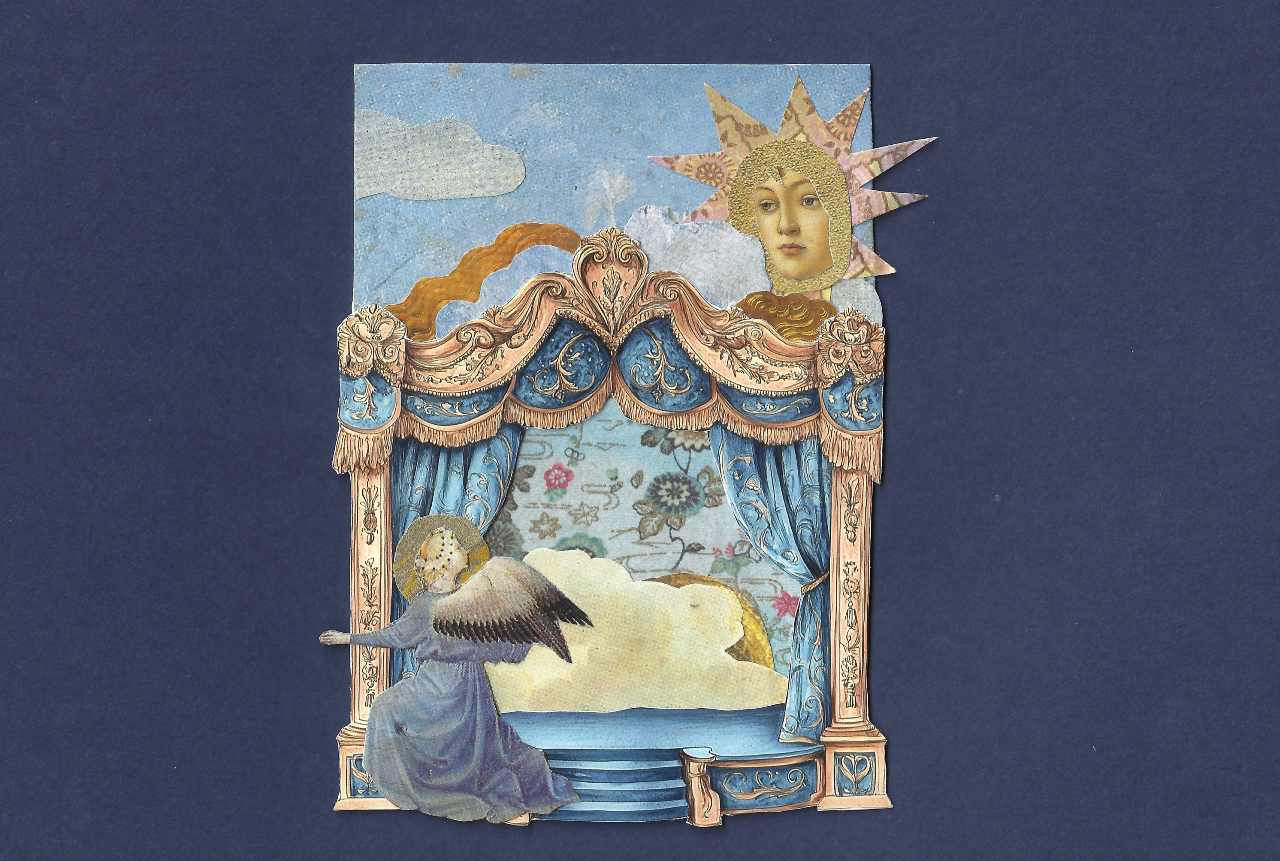
The hardest sentence to write in any piece, for me at least, is the first. (Now that I've done it, I can relax!) I have found that the only way to write something, a review, an essay, these editor's notes, is to begin with the beginning and move forward from there, or else I end up with a pile of notes and nowhere to go. When I was working with our creative director, Kay, on her beautiful collage for the issue's cover, we were shuffling through a literal pile: cutouts of Victorian paper theatres, shimmery Chiyogami, and Impressionist landscapes torn from books. We were worried about how it would look at the end, when we really just needed to glue something down.
We underestimate how hard beginnings are. The success of a film is weighed more on the ending: what threads it ties up and what it leaves to unravel. But the way a film announces itself with those first images and sounds is perhaps more defining. And some of the most memorable moments as a filmgoer happen before the proverbial curtain even goes up.
There was a screening of 2001: A Space Odyssey I saw on a Tuesday midday with about five other people in an enormous theatre. It was presented according to the original 1968 roadshow instructions in which the overture is played, ominously, over the closed red velvet curtain. Or a TIFF screening of Triangle of Sadness at the Princess of Wales theatre, when ushers had to keep ushering people out of the balcony's front row since it was reserved for very important people who never showed up—a moment of minor class hostility that is mirrored in the film's fashion show scene. And there are all the times one might take advantage of a loud trailer to surreptitiously open whatever food—or in my case, can of beer, or in my bold friend's case, bottle of wine—you've smuggled into the theatre. It's a time for hushed gossip, offering to get your friends something from concessions, taking off your coat, and putting your phone away. In short, it's romantic.
And then the lights go out and the film starts, and that's when I pass the microphone to our brilliant contributors who discuss beginnings of many kinds: from the unforgettable opening credits of Jackie Brown and both Psychos, to a director's haunted debut and the first outings of an actor turned director, haunting in retrospect, to a film that claims more than one first and the firsts of a genre that is still new.
You'll want to skip the bathroom line at intermission, since we will have a few pieces to keep you entertained while you wait for the next act. And stay through the end credits with our winter issue on endings, which will cover Kubrick stares, freeze frames, and last dances.
Enjoy the show!
—Gabrielle Marceau
Editor-in-Chief, In The Mood Magazine
The hardest sentence to write in any piece, for me at least, is the first. (Now that I've done it, I can relax!) I have found that the only way to write something, a review, an essay, these editor's notes, is to begin with the beginning and move forward from there, or else I end up with a pile of notes and nowhere to go. When I was working with our creative director, Kay, on her beautiful collage for the issue's cover, we were shuffling through a literal pile: cutouts of Victorian paper theatres, shimmery Chiyogami, and Impressionist landscapes torn from books. We were worried about how it would look at the end, when we really just needed to glue something down.
We underestimate how hard beginnings are. The success of a film is weighed more on the ending: what threads it ties up and what it leaves to unravel. But the way a film announces itself with those first images and sounds is perhaps more defining. And some of the most memorable moments as a filmgoer happen before the proverbial curtain even goes up.
There was a screening of 2001: A Space Odyssey I saw on a Tuesday midday with about five other people in an enormous theatre. It was presented according to the original 1968 roadshow instructions in which the overture is played, ominously, over the closed red velvet curtain. Or a TIFF screening of Triangle of Sadness at the Princess of Wales theatre, when ushers had to keep ushering people out of the balcony's front row since it was reserved for very important people who never showed up—a moment of minor class hostility that is mirrored in the film's fashion show scene. And there are all the times one might take advantage of a loud trailer to surreptitiously open whatever food—or in my case, can of beer, or in my bold friend's case, bottle of wine—you've smuggled into the theatre. It's a time for hushed gossip, offering to get your friends something from concessions, taking off your coat, and putting your phone away. In short, it's romantic.
And then the lights go out and the film starts, and that's when I pass the microphone to our brilliant contributors who discuss beginnings of many kinds: from the unforgettable opening credits of Jackie Brown and both Psychos, to a director's haunted debut and the first outings of an actor turned director, haunting in retrospect, to a film that claims more than one first and the firsts of a genre that is still new.
You'll want to skip the bathroom line at intermission, since we will have a few pieces to keep you entertained while you wait for the next act. And stay through the end credits with our winter issue on endings, which will cover Kubrick stares, freeze frames, and last dances.
Enjoy the show!
—Gabrielle Marceau
Editor-in-Chief, In The Mood Magazine