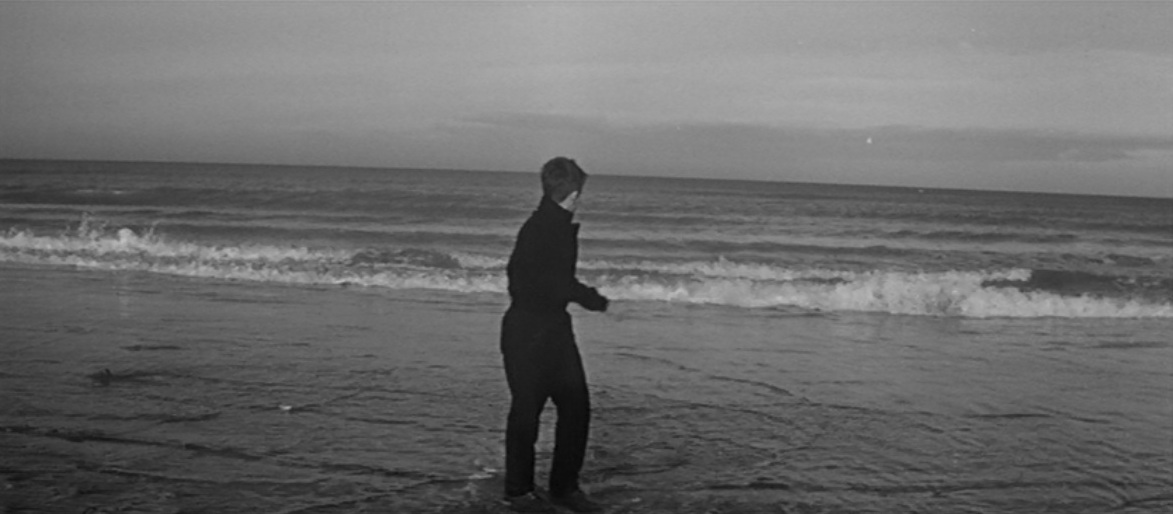

He can die now: that’s what I felt after sending you that last postcard from Marseille, the one about Jean-Pierre Léaud. A little evil, that feeling of relief, like a lie gone uncaught, or a knotted scarf loosened. The scarf is 100% silk, and stolen. I threw your postcard into the sea by walking straight into it, like Antoine Doinel in the final scene of François Truffaut’s The 400 Blows (1959). It’s not a walk so much as a trot, really. He has run away from a juvenile detention facility and has been running (such short little legs!) for a very long time. It is described in Truffaut’s original screenplay like this: “On the beach. Daytime. Low tide. Antoine goes forward first at a run, then very slowly, toward the water line, with its small ripples. He stops only when the foam starts licking at the soles of his shoes. He raises one foot, crooks the other, moves back, advances, moves back again […]. The last image here, Antoine at the shore, becomes a still […].” He is weary and alive; he has finally found the water. Rimbaud was seventeen when he saw the sea for the first time; Antoine Doinel, the layer cake character of Léaud and Truffaut, was twelve. I told you I’d write more about Rimbaud in my next letter and I’m sorry it’s taken me this long to return to it, to you, to Léaud: “the teenager, the glimmering beginning and also the end, always already the end because Léaud began and ended with Truffaut,” which is what I remember of the end of a sentence I wrote in my last letter. Now I’m wondering if Léaud didn’t begin and end in this final scene of The 400 Blows; if Léaud didn’t begin and end in that freeze frame on the water. His young face, freed and frozen, a portrait of an adolescence without end—and by the end of this postcard, I want you to understand that this is a metaphor. I’m writing to you now not from Marseille but Toronto; I have no green desk this time but the theory of a green couch. It’s as boring as adoring Paris to note that Toronto in December is inferior to Marseille in June, and for this reason I’d previously considered backdating the postcard. I wanted to lie like Doinel sometimes “prefers to” lie and tell you I was writing from a place called Lovesick Lake—that name deserves memorialization, I thought—but I can no longer summon the texture of October. It was a time when I was thinking about the ending of The 400 Blows and the end of Léaud and the end of an argument but also I was late on a deadline. The deadline was for the translation of a book about various ends of the world—most of them zombie apocalypses represented on television—and I was at Lovesick Lake, watching The Leftovers and calling it research. Now I’m in Toronto. The translation is finished and so is the argument, for now, and 2025, for good. It’s December, and from its shore I look out and watch all around me rise the waves of synoptic attitudes that have come to accompany the end of a year. These stunning—by which I mean stultifying—acts of reduction/synthesis/condensation tend to give me the feeling that we have, all of us, already died, that we have, all of us, already seen the end of the film, or the end of our lives. Sorry. I’ve drifted away from Rimbaud and turned bleak, but you can’t blame me: remember it’s December, remember it’s Toronto. And why Rimbaud? Rimbaud because once I was made to notice how the last shot of The 400 Blows—the freeze frame of Léaud’s face—resembles a famous photograph of Rimbaud, the photograph taken by Étienne Carjat in 1871, the same year that Rimbaud first saw the sea. And Rimbaud because like Truffaut his name rhymes with Léaud, although there was a time in my life when I didn’t know French and pronounced his name in a way that rhymed with slim bod. And Rimbaud because of a book written in French about Léaud that I bought on the same morning I took the train from Paris to Marseille, the morning I started to write about the subjects of my life that are Jean-Pierre Léaud, correspondence and friendship, and beginnings, which is also to say endings. The book is small and white, its epigraph from Rimbaud’s A Season in Hell: “Out of joy I took on an expression as clownish and blank as possible.” In the book that sentence appears in French—de joie, je prenais une expression bouffonne et égarée au possible—but for your sake I’ve looked up Louise Varese’s translation; another translation offers the adjectives “comic” and “wild.” Rimbaud wrote that sentence when he was twenty. You can smell the salt in it, hear the echoes of an audition interview from ninety years in the future, and see the face, clownish or comic, blank or wild, that belongs to Léaud, frozen and freed and framed by the water. The two translations, when pressed together onto a postcard, are bewildering. It’s bewildering to try to imagine a thing that may be understood as blank and wild at the same time. The thing is Léaud’s face and it contains, as I’ll spend the rest of my life trying to tell you, everything. Rats. Like Léaud I’ve run for too long in one direction and now have nearly arrived at the shoreline that is the end of this postcard with one last thing to tell you. With the remainder of this white space I move back, advance, then move back again: Truffaut went on to make four more films about Antoine Doinel: Antoine and Colette (1962), Stolen Kisses (1968), Bed and Board (1970), and Love on the Run (1979). Taken with The 400 Blows these films comprise what is called the Antoine Doinel cycle, a twenty-year-long stare into “the theme of the theft of childhood,” which are words I’ve stolen from Chris Fujiwara. The cycle is a lesson in endings, or one man’s avoidance of them. Another lesson: a translation is never finished. And speaking of endings, in Truffaut’s last interview, about the Antoine Doinel cycle, he says that “I wonder if he’s not too frozen in the end,” but of course he is frozen, and of course it is because of this that Léaud—here I thank God or Rimbaud or the sea—will never die, will always be looking at Truffaut, at his entire life, into the mirror that is the camera on the water. To the question, “Why did the Antoine Doinel cycle come to an end?” Truffaut said, “I guess because the ideas I get about Antoine Doinel, and the way Léaud plays him, are closely tied to adolescence; there’s something in the character that refuses to grow up. […] There is a lot of childhood left in all men, but with him, it’s even more so.” Léaud, elsewhere: “Personally, I would have never renounced or stopped Doinel.” There’s probably no good way to end a letter about the boy who hates “the end of the month, the end of the road, the end of the movie. I hate things that end.” But have I ever told you how much I hate the wind? The thing Rimbaud once called, in another poem, “so salubrious,” or in a different translation of the same poem, “wholesome,” and now I'm bewildered all over again, because I can think of nothing more antithetical to health than a midwinter gust to the face. But maybe I should cut Rimbaud some slack. It's possible that the wind is only ever so baleful on Bloor, the least salubrious street in the world. Bref. I’m throwing this postcard into the end of this year—look at it go, poof into pieces, freed and hopefully soon found, somewhere, wherever you are, and saved from the stupid wind.
“He stops only when the foam starts”:
on Jean-Pierre Léaud, again
a postcard from the shore of 2025
by Claire Foster