


1.
Adrienne Shelly had a rule about blind dates: she only let them last five minutes. Maybe the constraint allowed her to weed out the weirdos, or maybe she couldn’t stand the thought of wasted time. She met Andrew Ostroy at 35, at which point she had already accomplished more than many of her peers: she’d starred in a string of indie films; she’d been photographed on the cover of SPIN, making out with Evan Dando of The Lemonheads; and she’d written and directed several of her own features, the latest of which starred the Brat Pack’s Ally Sheedy. Still, she had more ambitions, more ideas, more scripts to write. She wanted to fall in love, start a family. She met Ostroy on Match.com, a platform that perfectly dates the period of their brief courtship. On their first date, Shelly broke her own rule and allowed the evening to last several hours. A year later, they were married. Soon after, a baby.
2.
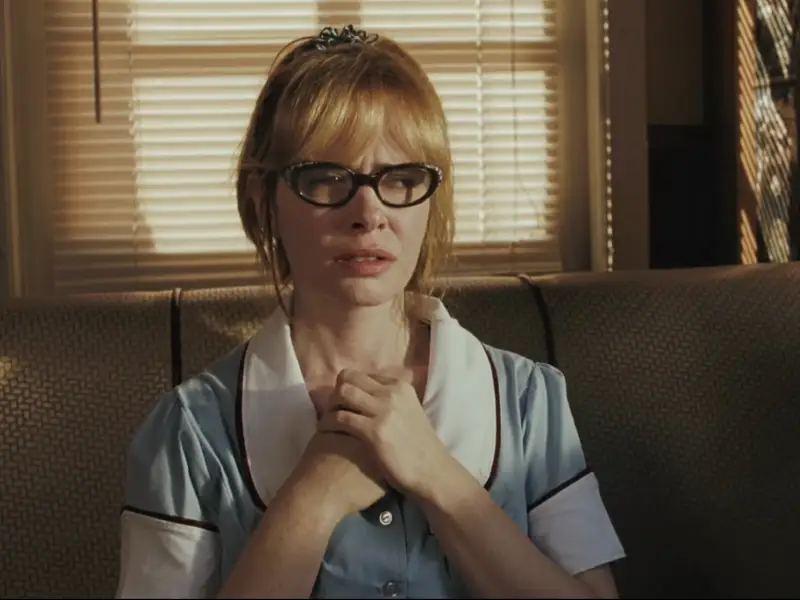
The idea came to Shelly while pregnant. Her anxieties about motherhood, how it might change her as a person and an artist, birthed a character named Jenna, a waitress at a roadside diner in a nondescript town in the American south who’s stuck in an unhappy marriage with a man named Earl. A pie-baking savant, Jenna fantasizes about winning the blue ribbon at the local pie contest and using the prize money to escape from Earl and start a new, wonderful life. (Note the similarity to Audry in The Unbelievable Truth (1989), another character limited by social and financial circumstance). This dream becomes complicated by the fact that she’s pregnant, a discovery that leads her into the office and soon into the arms of the kind and hunky Dr. Pomatter, a young obstetrician newly arrived in town with his wife. Suddenly Jenna finds herself caught between the two men, one so cruel and insecure that his first instinct when he learns of her pregnancy is to make her promise she won’t love the baby more than him, and the other so awkward and bumbling that he struggles to ask her out for coffee, which she can’t drink anyway because she’s pregnant. This lopsided triangulation sets the stage for a quirky and colourful meditation on happiness, self-determination, purpose, fulfilment, and love. The movie was a hit, a critical darling turned cult classic, later adapted for Broadway. It was Shelly’s most successful feature as well as her last, an irony she wouldn’t be alive to enjoy. She titled the project Waitress (2007), meaning a woman whose job is to serve.
3.
Gaby Wood in The Guardian described the day of the murder according to Diego Pillco: “That day, he said, Shelly had come down to the apartment where he was working and complained about construction noise. He didn't speak much English, having recently arrived in the United States, but he understood when she threatened to call the police.” In Adrienne (2021), the HBO Original documentary directed by Shelly’s husband, Andrew Ostroy, Pillco gives a slightly different story: he says, through a translator, that he had a lot of debt, and so he started robbing the apartments surrounding his various construction gigs. He’d done it before and nothing had ever happened, but the day he got caught in Shelly’s apartment, things got out of hand. Ostroy alludes to Pillco’s unclear immigration status, but he doesn’t provide any more information about who this man is, what drove him to do what he did, or what his life has been like after his sentence, 25 years without parole for first-degree manslaughter. Ostroy’s bias as a director is both glaring and understandable, and while I would’ve preferred a more thorough and judicious approach to Adrienne Shelly, one that contextualized her career, legacy, and murder within a broader nexus of race, class, citizenship, and culture, maybe a documentary made by her grieving husband wasn’t the right place to look.
4.
Waitress’s initial table read featured Amy Sedaris and Paul Rudd, but the final cast solidified into the central love triangle of Keri Russell as the plucky piemaker Jenna, Jeremy Sisto as the pathetically possessive Earl, and Nathan Fillion as the patient yet panicky Dr. Pomatter. The rest of the cast includes Cheryl Hines, pre-RFK Jr., as Jenna’s server compatriot; The Walking Dead’s Lew Temple as Jenna’s deadpan diner manager; and comedy legend Andy Griffith as the diner’s curmudgeonly owner. Each performance strikes a balance between slapstick and pathos, resulting in a tragicomic tone perhaps best exemplified by the names of Jenna’s pie recipes, described between scenes as a recurring reprieve: “I Hate My Husband Pie,” “Earl Murders Me Because I’m Having an Affair Pie,” "Pregnant Miserable Self-Pitying Loser Pie.” This kind of ironic wit delivered by a cast of steely waitresses and angry dirtbags betrays Hal Hartley’s influence, but Shelly’s sensibility is decidedly more lighthearted and tender, comparable in quippiness to the television shows of Amy Sherman-Palladino, only less rigidly wholesome. Russell described Shelly as ambitious and clear, a director who knew exactly what she wanted. Hiding in the movie like an Easter egg, Shelly cast herself as Dawn, another server at the diner, who marries a suitor she meets on a five-minute date. “I have found someone who loves me to death,” she barks at an incredulous Jenna, tears springing to her eyes. Shelly plays the role silly and big, a far cry from the aloof ingenue she personified earlier in her career. She said her objective as an artist was to find the funny in the sad, an ethos she cribbed from her approach to life.
5.
What Ostroy’s documentary offers is a reflection of a husband’s grief, refracted through the grief of his daughter. 15 years old during its filming, Sophie Ostroy looks shockingly like Audry in An Unbelievable Truth, which is to say she looks just like the mother she remembers only vaguely from infancy. A series of recorded conversations outlines Ostroy’s attempts to answer Sophie’s questions about her mother’s death at age two, age four, age ten. Each attempt is accompanied by a schlocky line-drawing animation that, while cheesy, somehow doesn’t disrupt the haunting poignancy of each conversation. How do you explain this type of tragedy to a child? Ostroy does the best he can. He gives Sophie her mother’s old diaries, ones from her early days in New York, when she was trying to make it as an actor. He visits the high school Shelly attended in Long Island, the auditorium where she belted the choir solo and where, backstage, she sharpied her name on the wall alongside her late father’s. Sophie flips through an old yearbook, finds the quote under her mother’s photo. “Don’t be afraid of dying,” she recites, “be afraid of never living.”
6.
For the entirety of her pregnancy, Jenna is ambivalent. She eschews well-wishes and gifts, grimacing whenever anybody suggests excitement. But once the baby is born, Jenna is reborn too. Still in the hospital bed, she summons the courage to tell Earl to fuck off, then tells Dr. Pomatter to fuck off, then wheels herself and her baby to the car. Cut to a few years later, Jenna is now the proprietor of her own pie shop, an apron around her waist and a toddler on her hip. The last shot of the movie shows Jenna and her baby, played by Sophie Ostroy, as they leave the pie shop and walk down a tree-lined road, the credits rolling as they disappear into the distance. One can imagine how heartbreaking it must’ve been to watch this ending for the first time at Sundance, only a few months after Shelly’s death. Subsequent reviews highlight the bittersweet circumstances of the movie’s release, but they also make pains to mention the whip-smart humour and the deft directorial touch, both signs of a woman who, much like the lead character she developed, had come into her own and was ready for the future.
7.
Who knows what stories Adrienne Shelly would’ve told had she had more time. She left behind a number of unfinished projects, including a documentary about happiness, the unedited footage of which contains a series of interviews wherein Shelly sets up a table in the park and asks strangers about what makes them happy. (“I guess I should admit that I’m really not such an expert on it,” she quips, poking fun at her own narrative authority.) In a similar gesture, Ostroy begins his documentary by approaching a group of tourists standing in line for a Broadway musical. He says he’s making a movie about Adrienne Shelly. Do they know who that is? The tourists shake their heads in total bewilderment, while the marquee above them reads based upon the motion picture written by Adrienne Shelly. “They don’t know who she is,” Ostroy says to the camera. “That to me is profoundly sad.” Undeniably so, but it’s also a little bit funny.