


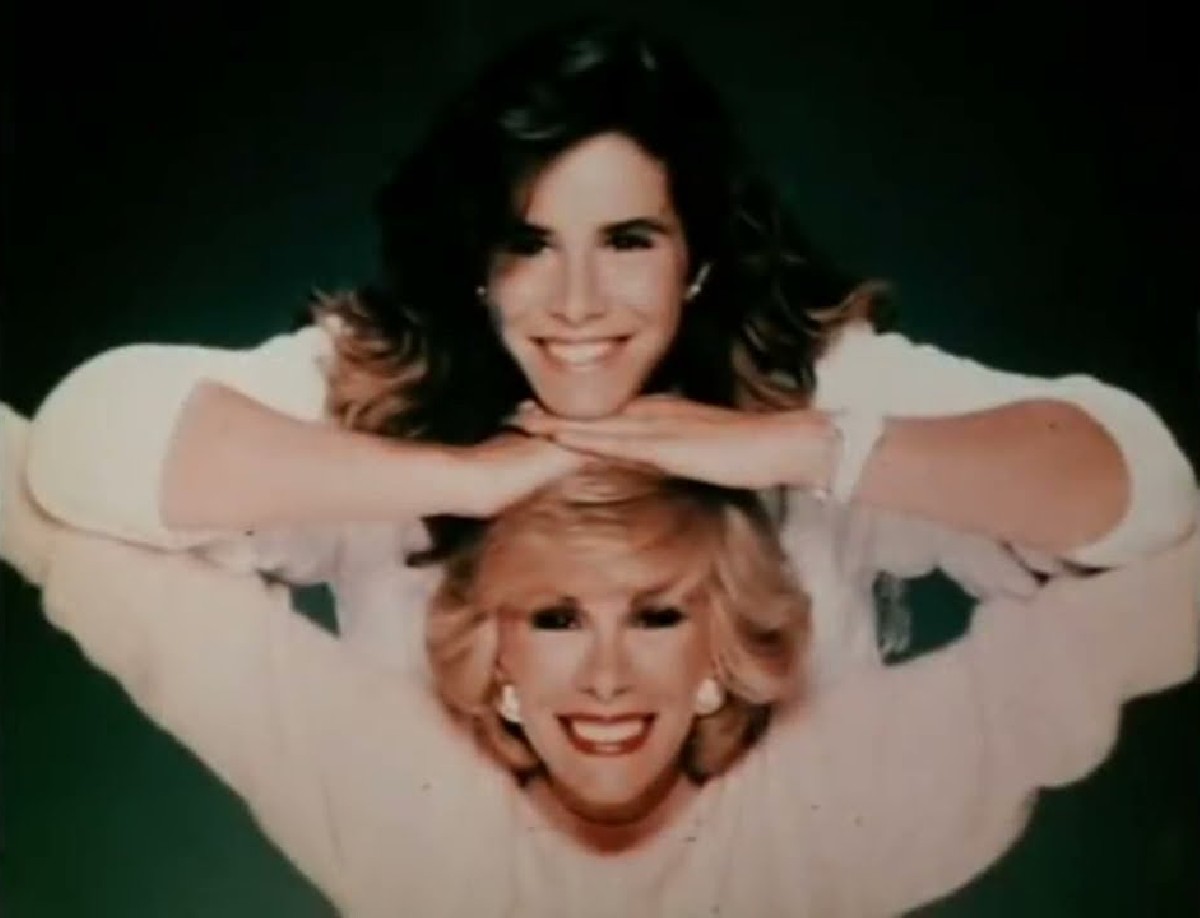
My Year of Magical Thinking, Joan Didion’s psychologically precise account of the year after her husband John Gregory Dunne’s sudden death, is perhaps one of the most famous contemporary meditations on grief. Less known is Joan Rivers’ Tears and Laughter: The Joan and Melissa Rivers Story (1994), the made-for-television film with a not dissimilar premise, in which mother and daughter play themselves in a reenactment of 1987, the year after Edgar Rosenberg, Joan’s husband and Melissa’s father, killed himself in a Philadelphia hotel room. There’s not much connective tissue between the two Joans, who were born but a year apart; one loud, audacious, self-deprecating Jewish comedienne, the other an austere giant of letters, notoriously soft spoken, and famously WASP. And yet, in Tears and Laughter, there is a moment in which Joan Rivers, emaciated—both late women would be thrilled by this description—wearing a neat blonde bob and an uncharacteristically unvarnished black turtleneck, bears an uncanny resemblance to Didion. It makes me laugh to imagine Didion in a Lifetime movie recounting her year of magical thinking, newly widowed, like Rivers, cracking jokes about Beverly Hills funerals (“people are so shallow they only bury them three feet deep”).
"...there’s something psychologically fascinating about Joan and Melissa’s re-performance of grief."
It is not difficult to imagine what the writer of “On Self Respect” might have thought of the Rivers women’s gaudy depiction of grief, replete with a histrionic organ soundtrack, Giallo-esque screen fades to red, and Seinfeld-style interludes of Joan Rivers’ own standup routines. (“The charms that work on others count for nothing in that devastatingly well-lit back alley where one keeps assignations with oneself,” Didion wrote. “No winning smiles will do here.”) When the film aired on NBC in 1994, critics were likewise quite galled: the film was derided as “tacky,” “unthinkable,” and “a lot like being locked on an emotional treadmill.” "Were [it] not so ghoulishly creepy,” Ken Tucker wrote in Entertainment Weekly, “it would be an instant camp classic." Though stylistically indistinguishable from countless straight-to-cable specials, somehow both flippant and maudlin about the death of a loved one, and blessed with a particularly unconvincing turn from 26-year-old Melissa as her college-aged self, there’s something psychologically fascinating about Joan and Melissa’s re-performance of grief. The film could have no other function—certainly not as art, and barely plausibly as comedy—other than as a kind of psychodrama for the mother and daughter. The film, which features a performance of the duo in therapy, posits that the only way for the Rivers women to grieve is to run the past on a treadmill to try and overcome it.

The film shows no tact in depicting the Rivers women’s traumas: at the two-minute-forty-second mark, an over-the-shoulder shot tracks Edgar as he downs the contents of a pill bottle with a drink, overtop his suicide notes neatly labelled on his desk. (Joan, meanwhile, is getting liposuction). It’s a mise-en-scene that bears little ambiguity; just as twenty minutes later, when a smarmy agent tells Joan, whose hugely successful comedy career is suddenly flagging, “Nobody wants to see a woman whose husband just killed himself try to be funny. Your talk show is regarded as a failure, therefore you are a failure. You are unbookable.” He promptly fires her. You’d be hard-pressed to find this sort of directness in Play it As it Lays.
From here, director Oz Scott, behind other camp classics including Dirty Dancing (1987), Mr. and Mrs. Smith (2005), and The Cheetah Girls (2003), is so forceful with the film's central conflicts that they may as well be telegraphed in the Broadway lights where Joan stages her comeback. The schism between the mother and daughter is reiterated at every turn. Edgar has left Joan in debt, and so she immediately hits the club scene to regain her financial and emotional standing, much to the chagrin of audiences and Melissa, who expect her to perform the requisite mourning, preferably at home and in all black. (Her late husband had it in his will that “he should be cremated and his ashes scattered all over Neiman Marcus, because at least he knew that way I’d visit him every day,” Joan tells a Just for Laughs crowd.) Melissa, in scrunchies and Princess Diana-inspired crewnecks, reluctantly returns to the University of Pennsylvania for her senior year. “I feel so frozen, like I can’t communicate. Not even with my mother, which is probably just as well because she’s never home to talk to anyway,” she tells a bad news boyfriend. “She wants me to be the widow on the hill, she wants me to sit on a chair and grieve,” Joan says of Melissa. Joan, for what it’s worth, outpaces Melissa in these fraught moments. This painful reminder that talent is not necessarily democratic nor hereditary will echo some-thirty years later when Joan trounces her daughter in Season 2 of Celebrity Apprentice.
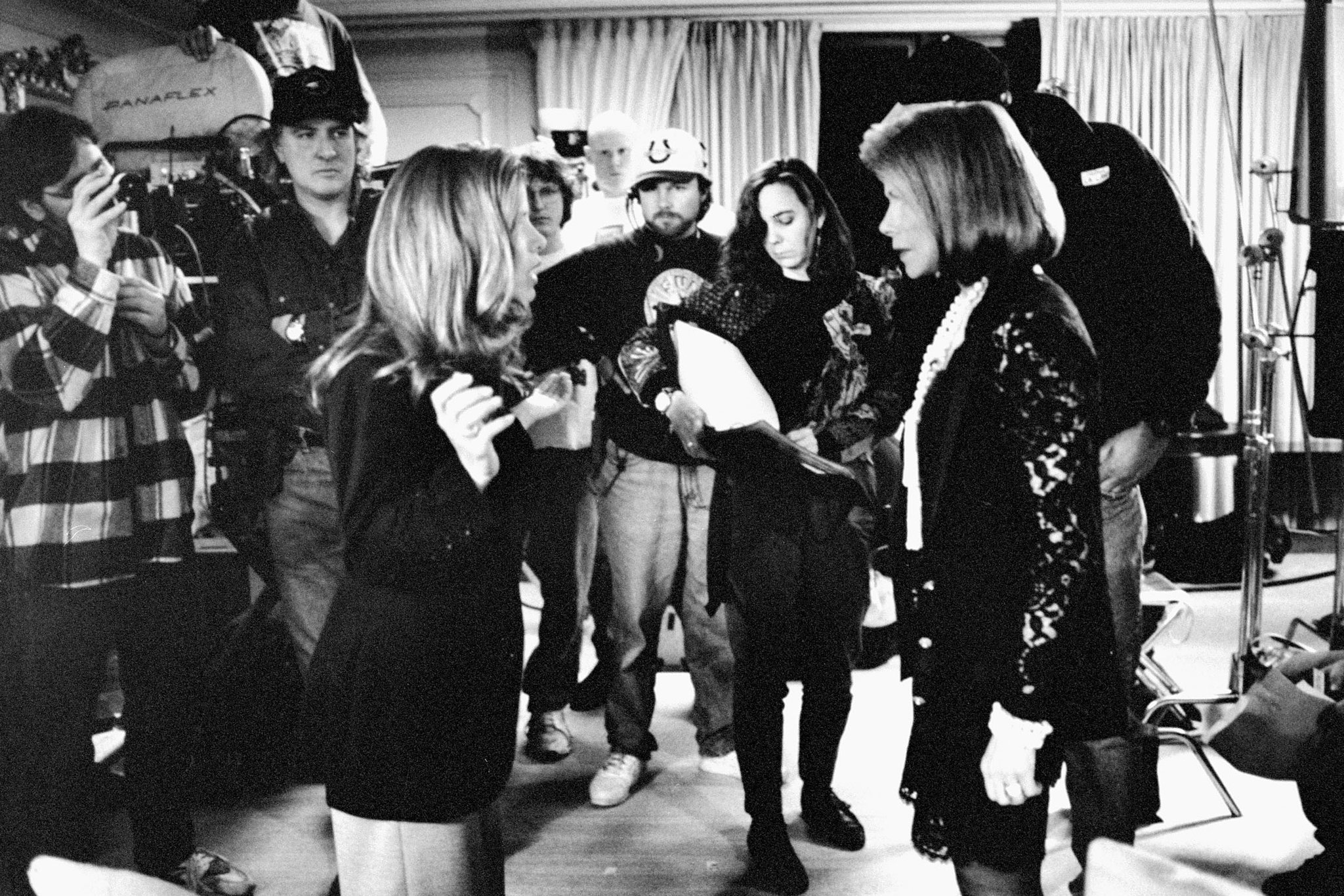
If their emotional outbursts feel painfully on the nose, they’re also somehow truer to the mother-daughter relationship, in which such scripts are recited not because they’re felt but because they’re remembered, and all fights are about some warped memory of a missed recital decades prior, confabulations calcified in each retelling. Tears and Laughter takes something of a meta turn: “Do you need to be such a drama queen?” Melissa asks Joan. “Do you need to turn everything into such a soap opera? You always cast yourself as the star of a Joan Crawford movie.” Mommy Dearest, in turn, will insist that this soap opera of theirs need not have a tragic ending in her Broadway debut. “The movie isn’t over yet,” she says, in character, to resounding applause. They purge the old refrains of their relationship, and finally, the duo can reconcile. It makes me consider if, in Blue Nights, Didion's follow-up to My Year of Magical Thinking, about the death of her only daughter Quintana Roo, her meditations on motherhood aren’t poetic but evasive. Quintana, Didion writes, drank more than she should, sometimes because she was depressed, other times anxious. “Alcohol has its own well-known defects as a medication for depression,” she writes. “But no one has ever suggested—ask any doctor—that it is not the most effective anti-anxiety agent yet known.” One wonders what would have happened had she just said it straight: my daughter's an alcoholic and I’m an anorexic.
At the film’s end, Joan Rivers delivers the commencement address at Melissa’s graduation. Melissa is in all black still, but Joan has shed her widow's garb for a bubblegum pink set. “They invited me because I’m funny and I’m caustic and I’m cheap,” she says, before bestowing sincere congratulations upon her daughter. Both of them tear up, and Joan gets a standing ovation. The camera fades a final time to red, before cutting to Joan, who delivers something of a PSA on grief straight to the camera, “Here’s something that became crystal clear on that terrible journey. There is this incredible gift that’s yours if you’re lucky enough to have a daughter,” she says with a hoarse voice. “You’re going to find out you’ve given birth to your own best friend.” That a daughter can be your salvation is not a truism of widowhood, nor is it particularly sound parenting advice, but I sob every time.