


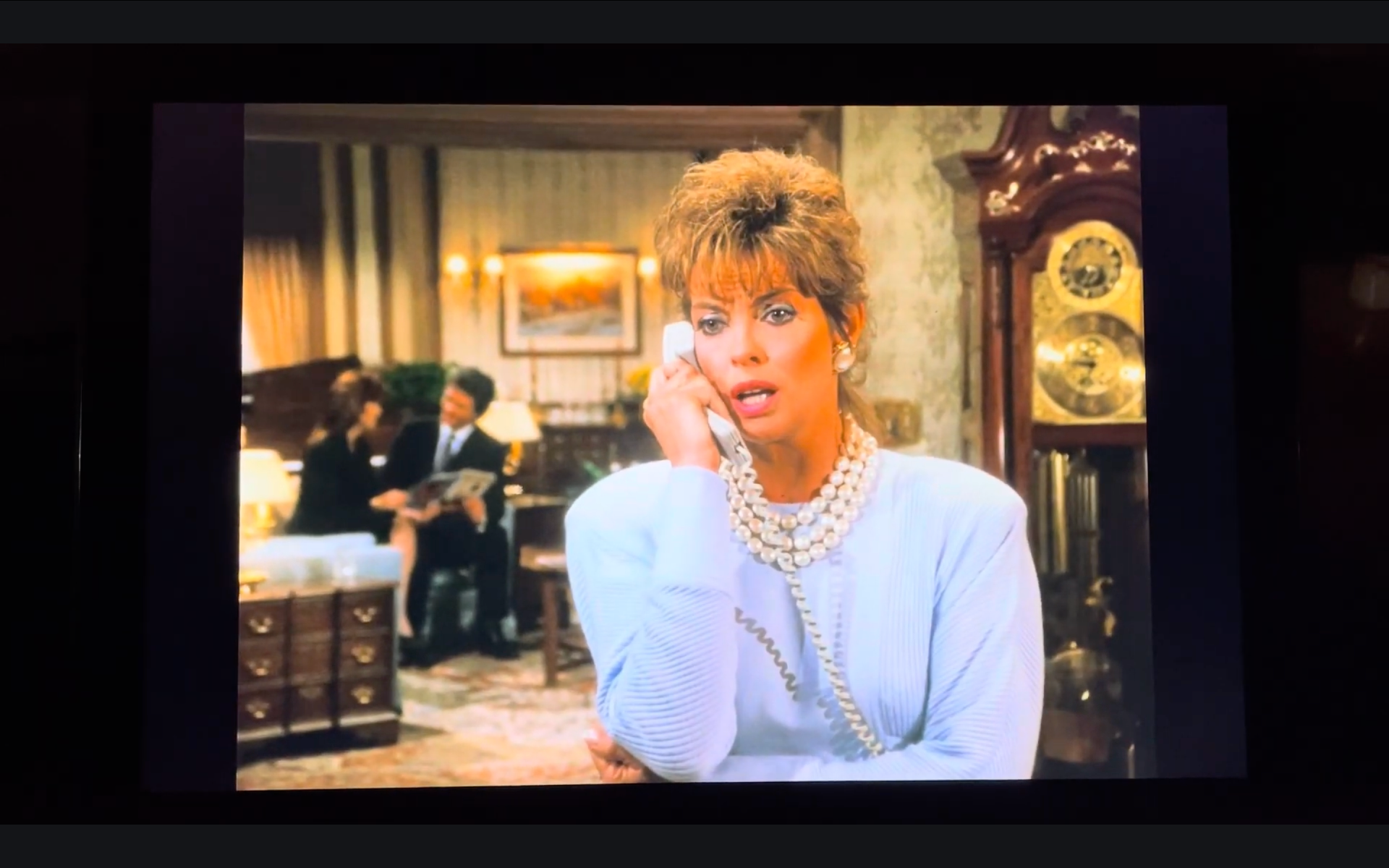
I would like to present my findings to date on an object of ongoing obsession: the gesture of taking off your clip-on earring to talk on the landline. I’ve been scouring the internet for examples in film and television, using variations on the search terms “woman”, “taking off clip on earring”, “landline”, “eighties”, “phone”—with very little success, not even a video compilation! When I bring up the clip-on-landline thing in conversation, its citation is often met with recognition and even delight, yet it still seems to be an under-mapped gesture. Here, then, is a report on one possible research path: thinking about artifice, plastic, and Dallas.
First, to define the gesture: The landline rings. The receiver is picked up with one hand. Simultaneously, the other hand reaches across the body to pluck the wearer’s earring off the ear on which the receiver will be placed. The head tilts slightly. This is executed as one smooth motion, one that can be coloured by the wearer’s countenance—often serene, but sometimes also flavoured with irritation. No matter its tone, this gesture always retains what we will hereafter refer to as “glamour”. It is a gesture I most associate with “the long nineteen eighties,” a seminal era for both clip-on earrings and landlines.
How might we take this gesture apart?
Let's separate it into elements: the performer, the earring, the phone; material, circumstance, style; plastic, receptivity, breath on the other line. The circumstance is often preparatory, the style crisp, the breath anticipatory. These congeal in the moment of the gesture, which we can locate within a broader performance.
Let’s take, for instance, Linda Gray’s performance as Sue Ellen Ewing in the television soap opera Dallas (1978-1991), documented via filming the television with a cell phone and uploading it to YouTube. In this clip, Sue Ellen receives a phone call. When called to the line by the maid, she strolls over, casually removing her clip-on mid-trajectory, her ear ready to receive a new message, unencumbered. She answers—”Yes, this is Sue Ellen Ewing with Valentine Lingerie”—only to learn that there had been an accident: Jamie Ewing Barnes, her cousin-in-law, was dead. It is up to her to tell her niece and nephew the tragic news, and as the music swells, the credits (yellow) roll.
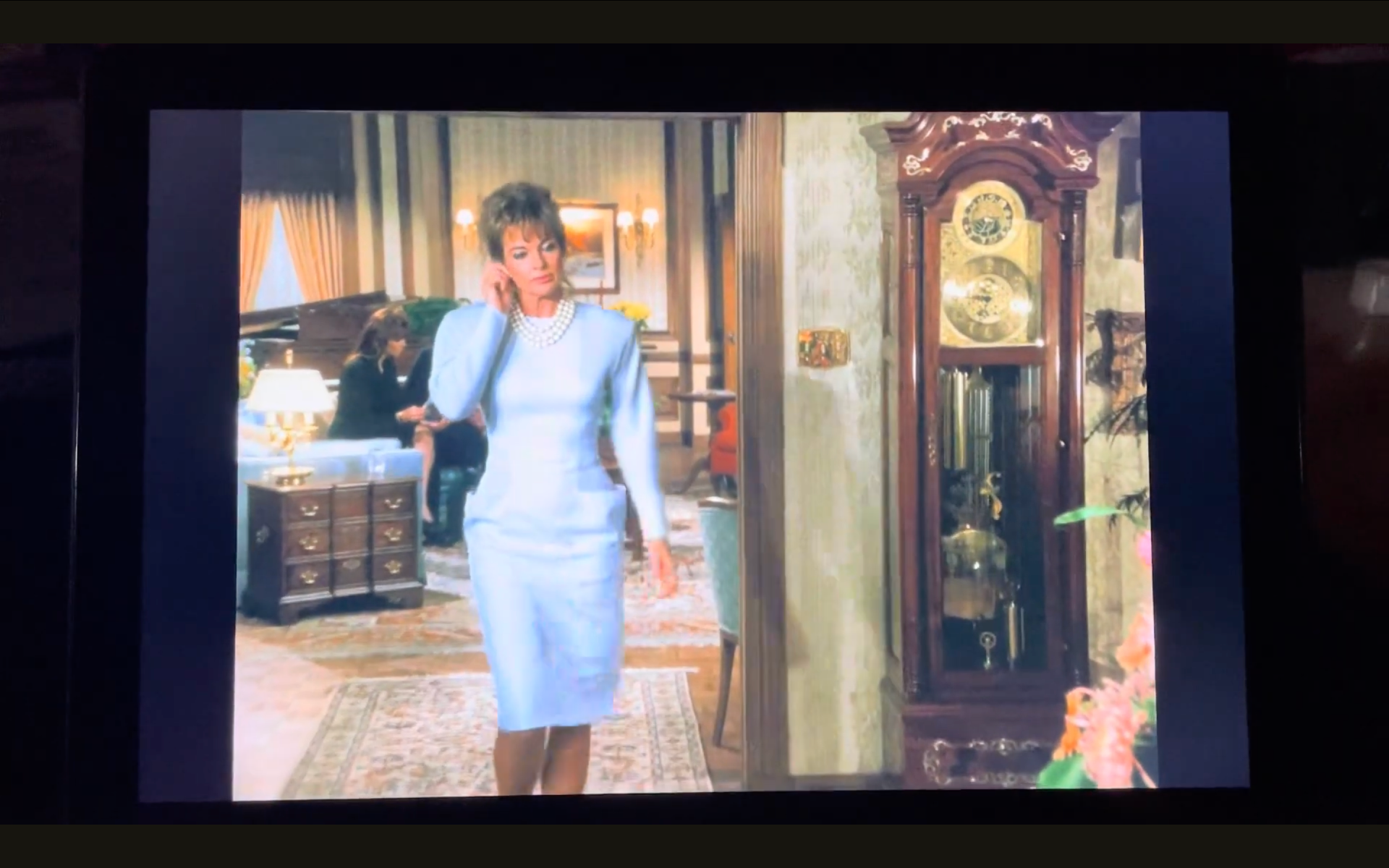
Dallas is a pool in which all the elements that interest me about the clip-on earring gesture leak into each other: a particular kind of synthetic (performed) femininity, melodrama, plastic objects, and Mother Oil. Women are always answering the phone, and whatever is being communicated on the other line will change their lives, and this happens every day. There is no moment of greater, more quotidian suspense than when the phone rings in Dallas.
Briefly: Dallas follows the exploits and affairs of the Texan Ewing family, owners of Ewing Oil. The origins of Dallas’ conflicts emerge, of course, from mixtures of business, pleasure, and patriarchal-petrochemical extraction. Oil, then, is Dallas’ foundation as well as its lubricant, furnishing the Ewings’ wealth as well as their rivalries, affairs, and material realities. When Sue Ellen sheds her clip-on and grips the landline (warming in her hand), she produces a relation not only between herself and the news she is to receive, but also between herself and wealth, oil, its plastic offspring, artifice and a kind of synthetic glamour.
(When celluloid, a proto-plastic plant-based polymer, was patented in 1868, its progeny included both film, of course, as well as imitation ivory or tortoiseshell, in the form of combs, handbag handles, and jewelry. Then came the first synthetic polymer, Bakelite, which was followed by other polymers derived from oil, natural gas, and coal, quickly becoming absorbed into material culture, including recording and communication media. Plastic, like film perhaps, and sometimes performance, is a technology of mimicry, of reproduction; Roland Barthes writes that “more than a substance, plastic is the very idea of its infinite transformation.” Plastic’s ubiquity gave the costume jewelry industry unprecedented juice. Why buy Bulgari when you could choose from a plethora of synthetic dupes? Costume jewelry designer Kenneth Jay Lane left us with the perfectly bitchy/pithy phrase “if I haven’t copied you, you’re not worth copying.”)
"What I like about the clip-on earring removal is that it is an interruption—it appears as one smooth motion, but it shows us a kind of micro crisis."
What I like about the clip-on earring removal is that it is an interruption—it appears as one smooth motion, but it shows us a kind of micro crisis. As the anthropologist Carrie Noland tells us, gestures reveal the meeting point between body-as-lived-body and body-as-sign. Clip-ons represent a means of inhabiting a heightened femininity, but they also present a logistical problem when speaking on the landline: they become uncomfortable with the receiver pressed up against the ear, and they create a distracting tapping sound on the line. When we see clip-ons removed in Dallas, the gesture reframes the static costume earring as something more dynamic—a plastic index of repeated motion, a mode of performance as much as adornment. For one second, we see an irregularity in the augmented surface of soapy glamour (permed, glossed, extracted). We glimpse a point in which the performance contends with material reality: even though it’s likely Gray was performing a one-way phone conversation, the inclusion of the gesture is a residue of its presence outside the diegesis. It registers as both glamourous and quotidian, artificial and inhabited.
Lesley Stern writes that “gestures are performed individually, but they are not possessed by individuals. They acquire force and significance through repetition and variation.” In soap opera forums, there is sometimes debate about the clip-on removal: some say they’ve never seen anyone do this, others reminisce of grandmothers and aunts performing the technique. Really, it is a kind of extinct gesture, rarely practiced in a period of streamlined aesthetics and technologies (which prompt their own choreographies, perhaps). I wonder if we might think of its presence in film and TV as revealing a late twentieth-century structure of feeling (to use Raymond Williams’ term)—the affective experience of a Texan oil family’s gilded ranch, of a period shaped by excess, plastic, the smell of a new couch offgassing in your living room.
Episodes-worth of plastic clip-on earrings worn by Sue Ellen probably still exist, accruing some strange patina. Speaking on Douglas Sirk, Todd Haynes says that in melodrama, “the surface reveals everything.” I wonder, then, how melodrama tells us about itself through its materials as much as its narrative contours. Taking our cue from the glossy surfaces of Dallas, Sue Ellen’s clip-on earring removal reflects how synthetic materials shape everyday gestures, and how this both produces and disrupts a particular kind of performed glamour. When the clip-on is taken off the lobe, it leaves a space in which to collect residues and tensions: the limits of Sue Ellen’s agency within the narrative confines of Dallas, impractical adornment at odds with expectations of seamless availability, and the material, affective, and cinematic afterlives of petrochemicals. If “glamour” is to be located anywhere, I suspect it might be at its most potent in these uneasy spaces—between fluidity and friction, performance and extraction, real and synthetic.