


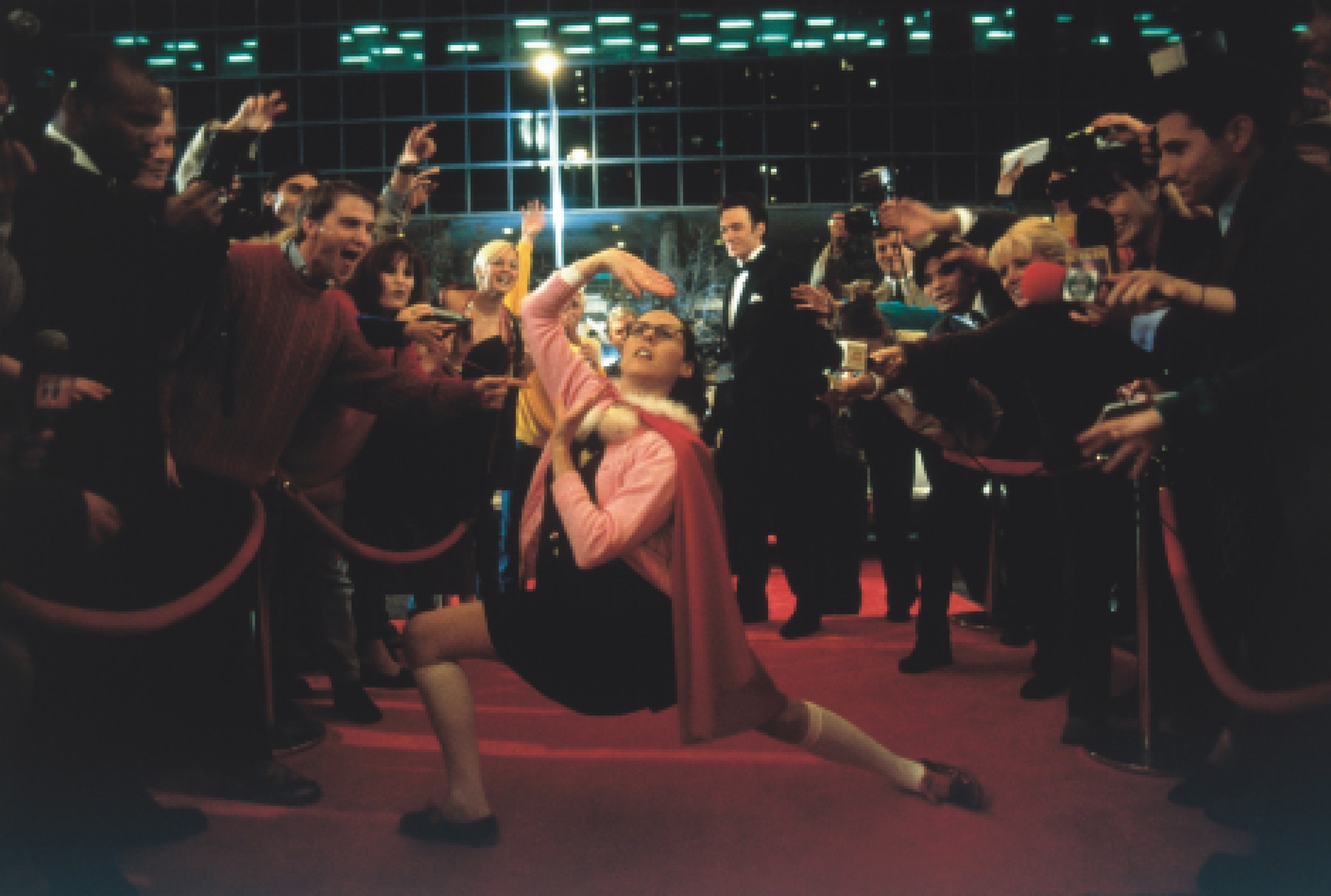
Directed by Bruce McCulloch of Kids in the Hall, Superstar exists in a world in which Catholic high schools launch campaigns to fight STIs and every teenager looks 35. I can quote the script from memory, having seen it a million times, and yet my heart still flutters every time I see the opening shot: an aerial view of a small town, the camera zooming in closer and closer to a rectangular pool before plunging itself into its chlorinated waters, just as “Beautiful” by the Go-Gos reaches its chorus. Through a voiceover soon after, Mary Katherine Gallagher, our hero, establishes the movie’s central dichotomy: there are people who enter the pool one foot at a time, letting their bodies adjust to the temperature, and then there are those who jump right in.
"...Superstar exists in a world in which Catholic high schools launch campaigns to fight STIs and every teenager looks 35."
Mary is a jumper, a frenetic ball of ADHD with a habit of sticking her hands under her armpits and then sniffing her fingers. Awkward and horny, Mary is a connoisseur of made-for-TV movies, an obsession that propels her to find romance in the form of a “big Hollywood fireworks type of kiss.” Twining her need to be loved with a desire to perform, she signs up for the school talent show, hoping that success on stage will lead to the kiss she craves.
Standing in the way of this goal are her peers, who bully her relentlessly; her grandmother, who would prefer she study business; and her own gracelessness, which she tries to cover up with plucky enthusiasm. Adjacent to this central plot are a series of fantasy sequences and cutaway gags—Mary making out with a tree; Mary fondling her boobs in the mirror; Mary giving an interview as a supermodel—which together form a character study of a girl whose eagerness to be witnessed is nothing short of brave.
Superstar is populated by a suite of comedy legends: Will Ferrell appears as Sky Corrigan, Mary’s smooth-talking crush, and then reappears ten minutes later as her hallucinated vision of God; Elaine Hendrix adopts her signature bitch-face to play Mary’s nemesis, a bulimic cheerleader named after bottled water; and Hollywood icon Glynis Johns, perhaps best known as Mrs. Banks in Mary Poppins (1964), plays Mary’s wheelchair-bound grandmother in the final role of her career. All of these performances, while well-executed, pale in comparison to the movie’s one true superstar, the mind and body behind its lead, the endearing and fearless Molly Shannon.
Shannon developed Mary Katherine Gallagher while studying drama at NYU, and continued to refine the character while working as an actor in LA. “Mary is very much an exaggerated version of myself and how I really felt as a little girl after my mom died,” Shannon has said, calling the character, and by extension herself, “anxious, over-dramatic, accident-prone.” In 1995, Mary made her debut on Saturday Night Live and quickly became a fan favourite, appearing in sketches alongside celebrity guests like Gwyneth Paltrow and Tina Turner. It was only a matter of time until His Royal Highness Lorne Michaels bequeathed Mary her very own movie. Julia Sweeney is the only other woman to have one of her SNL sketches turned into a movie, the poorly received It’s Pat (1994), based on an ambiguously gendered character of the same name, making Mary Katherine Gallagher the first (and only) character from SNL to make the jump to the silver screen as a female main character.
Initial reception to Superstar was tepid, with several critics dismissing it as another failed attempt from SNL to recapture the success of earlier properties like The Blues Brothers (1980) and Wayne’s World (1992). The New York Times called Mary Katherine Gallagher “a joy only for five minutes or so at a time,” while Roger Ebert called her “a character so sad and hapless, so hard to like, so impossible to empathize with, that watching [her] feels like an act of unkindness,” both of which reflect a culture eager to punish women, even fictional ones, for the crime of being obnoxious. Much like Mary’s on-screen detractors, these critics eventually ate crow. The movie, while by no means a commercial success, accrued cult status over time, transforming Mary Katherine Gallagher into a hero as memorable as those of John Belushi or Mike Myers. Several decades later, Shannon still encounters fans who quote the movie back to her.
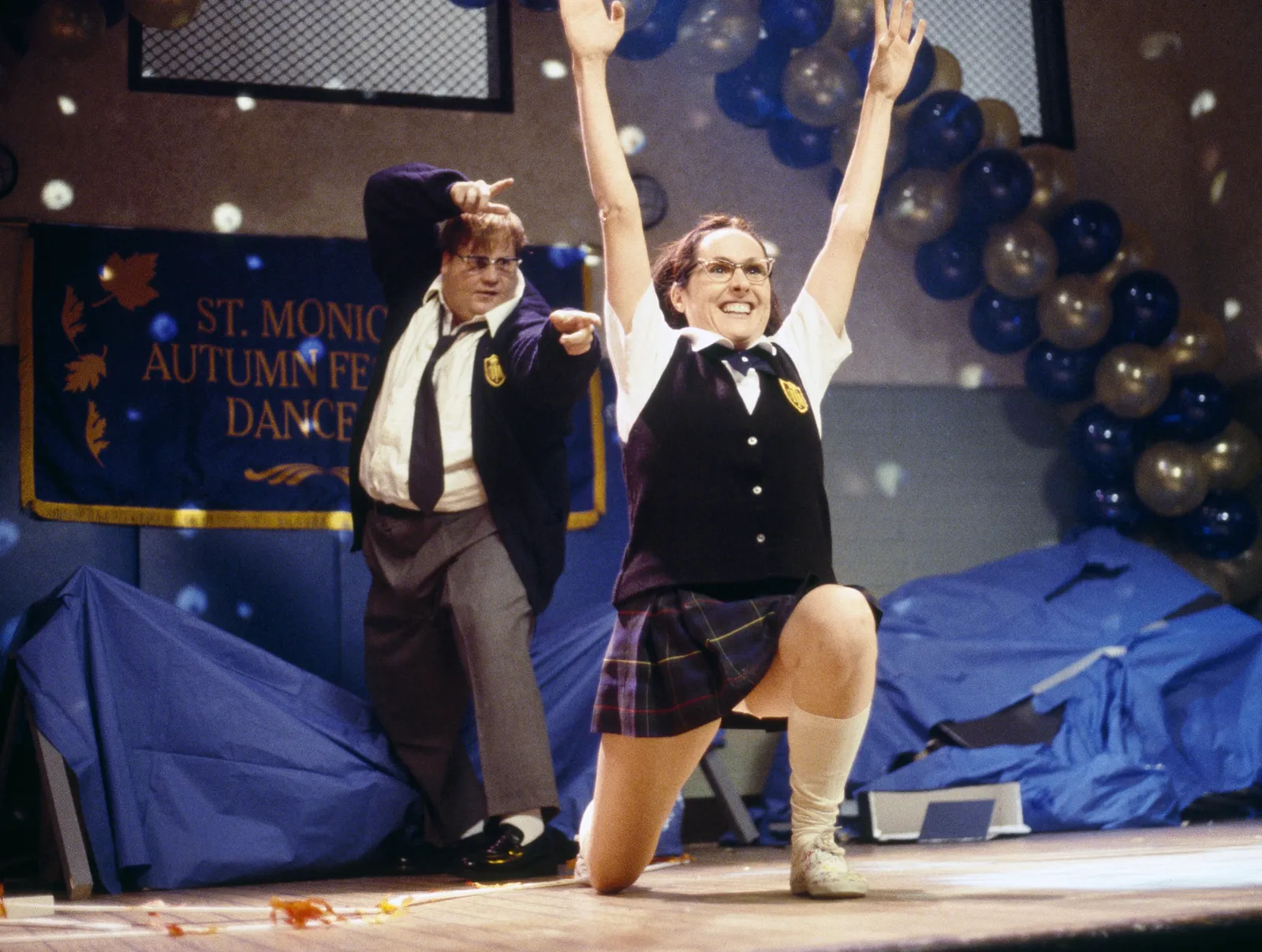
What is it about Mary Katherine Gallagher that repulses some and transfixes others? Part of this double-edged appeal may stem from Shannon’s commitment to chewing the scenery. So rarely is an actor willing to suck the bark of a tree, scream until the veins in her neck pop out, or destroy set pieces with such vigour. Her physical performance is on par with Lucille Ball, only Shannon is more bawdy, more raunchy, not afraid to let her panties show. She amplifies the naïve passion of teenage libido with big, jarring movements, and while I can appreciate that some viewers might find watching a grown woman embody the sexuality of a young girl uncomfortable, irritating, or tedious, I find the performance virtuosic, unique, and for what it’s worth, very funny.
"So rarely is an actor willing to suck the bark of a tree, scream until the veins in her neck pop out, or destroy set pieces with such vigour."
Or maybe the critical distaste for Mary Katherine Gallagher has to do with the fact that the character herself is a performer, that much-maligned figure who unabashedly begs to be seen. What’s worse, she’s a teenage girl, with no discernible talent to mask or make palatable that part of herself that so desperately wants attention. When Mary says she hates the way she is, I understand what she means. This naked desperation is not the most attractive trait, and who hasn’t asked to be looked at, known, and loved, only to feel the sting of self-hatred in the face of rejection? Not only do I empathize with Mary Katherine Gallagher, I admire her. It’s noble to allow yourself to be seen striving and failing, just as it takes courage to jump in the pool, trusting your body to absorb the shock. Such actions aren’t for the weak-willed or faint of heart. Not everybody has what it takes to be a superstar.