



Movie stars are movie stars in part because of the parasocial relationship between actor and fan. Certainly, audience identification is a big part of this—the feeling that an actor’s roles embody who you are, or, rather, who you want to be. But there's also the off-screen factor where we play armchair accountant, agent, or manager to millionaire movie stars. After a few flops, maybe we rethink the stock we bought in them. Why did they pick this movie? Why did they give this kind of performance? And sometimes, why did they “phone it in”?
This is one of the most common complaints lodged against big-name actors. “Phoning it in”: simply put, not giving their all in a performance. Even some of the greatest actors of all time have gotten this accusation: Marlon Brando, for one, had many such charges throughout his rollercoaster career, like his sleepy performance, which drew an all-time record paycheck, for Superman: The Movie (1978). It’s like being called the world’s greatest actor over and over again got to his head and made him want to fuck with his audience, critics, and peers.
"It’s like being called the world’s greatest actor over and over again got to his head and made him want to fuck with his audience, critics, and peers."
Some actors, consciously and effectively, underplay their performances, action stars like Clint Eastwood and Charles Bronson being prime examples of beloved quiet macho men. Even a rather stiff actor like Gary Cooper could put that reserved quality to meaningful use in the right role, like in the classic westerns he did with Anthony Mann and Robert Aldrich. But there seems to be a fundamental difference between stoicism and flatness, even if, in many cases, we can only feel it rather than articulate it. But there are times, though, when it’s not hard to understand that the actor is checked out. Case in point: the lopsided filmography of Robert De Niro—generally considered the greatest actor of the 1970s, but now, the ratio of good to bad films resembles the number of great seasons of The Simpsons to bad ones. Yet we have to consider an oeuvre as a whole, and all of De Niro's bad movies and phoned-in performances are important to his legacy, for better or worse.
Since the 2010s, De Niro has appeared in many “Geezer Teasers”; movies that employ a production model pioneered by Vanderpump Rules cast member Randall Emmett, where a low-budget genre film pays a fading star—be it Bruce Willis, Mel Gibson, or Sylvester Stallone—around 10 million dollars to do five days' work, and then pinches pennies on everything else. It works: having one established star, even if they are well over-the-hill, in the cast can get a film TV and VOD distribution on the international market. The films themselves are almost built around the idea of underachieving; hitting the bare minimum just to keep Randall Emmett’s factory conveyor belt moving.
While Robert De Niro was never an action star in the vein of most Geezer Teaser fixtures, he seems glad to stay in Emmett’s orbit. In De Niro’s case, it doesn’t take too much investigation or psychologizing to figure out where his film career’s priorities lie: at this point, he's more of a New York real estate mogul than an actor. There are rumours that De Niro will say yes to anything as long as it pays two million dollars, which he can reinvest in property. It seemed strange that he recently turned down a role in the next Batman movie, considering it would probably be a good payday. But as a friend of mine noted, in the months he’d spend filming in London, he could probably make three Emmett productions in Atlanta, earning more money while only a short private jet ride away from his New York business meetings.
There are De Niro performances that still show a bit of life, be it the calm, realistic depiction of an elderly man re-entering the workforce in Nancy Meyers’s The Intern (2015), or his raucous turn as the titular Dirty Grandpa (2016). And not to mention his two recent Martin Scorsese reunions that show he can be subtle without being dull. But when current De Niro comes to mind, my mind inevitably goes to something like the Emmett-directed Savage Salvation (2022), where he appears as a police officer for about 10 minutes. One can imagine the De Niro of the '70s, '80s, maybe even '90s really diving into the role of an Appalachian police officer struck by tragedy, putting in the time to nail the character's accent and physicality. Yet what we get onscreen is him mostly shot from the chest, probably to hide the fact that he was sitting down for most of his scenes—far removed from the man who gained 60 pounds for Raging Bull (1980).
If De Niro was the best actor of serious '70s dramas, then we can turn to arguably the biggest star of '80s comedy, Eddie Murphy, who likewise hasn’t escaped accusations of phoning it in. A prodigious comedic talent who burst onto the scene with Saturday Night Live at age 19, he arguably peaked with the original Beverly Hills Cop (1984), which came out when he was only 23 years old. How do you keep that energy going another couple of decades into middle age?
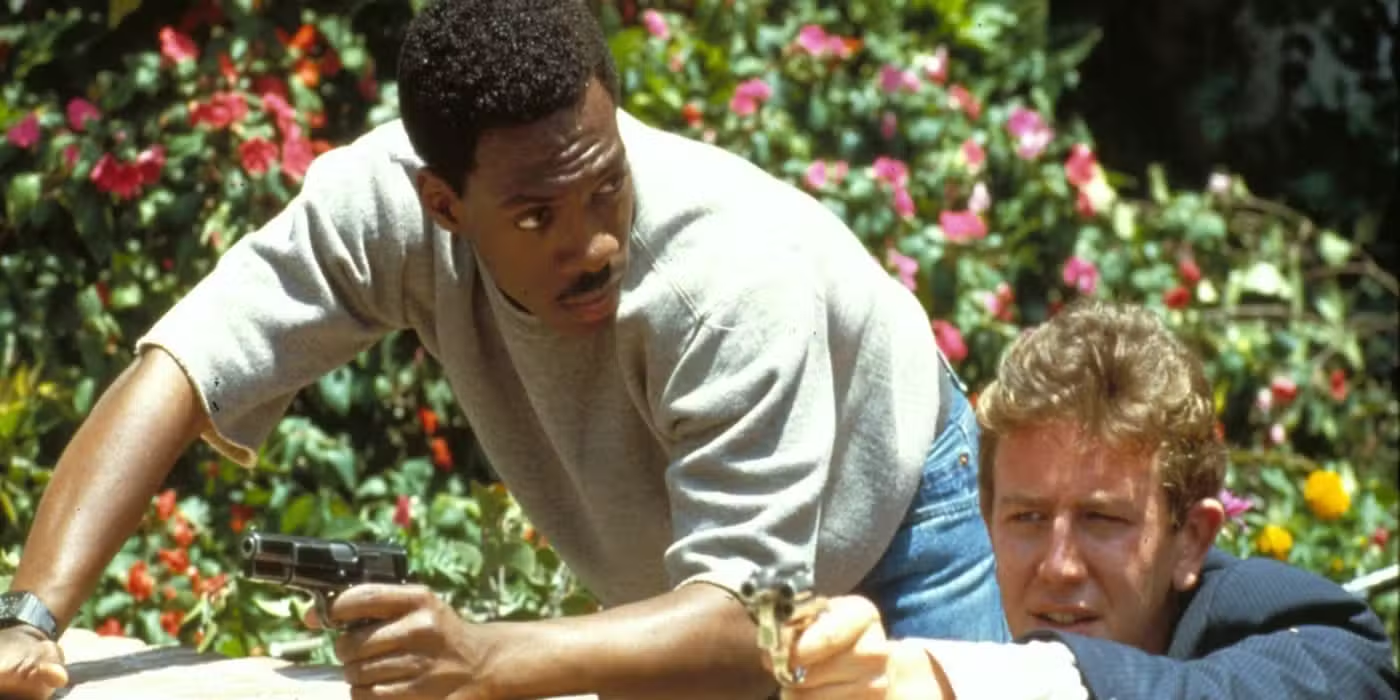
Only a decade after his biggest success, a sort of early midlife crisis had already formed when he appeared in 1994’s Beverly Hills Cop III. This is not a case where the question of "phoning it in" is arguable, but rather the official public record.
The film was promised to be a return to form for Murphy, who’d seen his star sinking after a number of bombs. For one, it was a reunion between him and director John Landis, who’d directed him in two of his most iconic performances in Trading Places (1983) and Coming to America (1988). Yet notoriously, Murphy refused to be funny, not taking any of Landis’s direction. One of the defining elements of Murphy's performance style is his big grin, but at no point in the film does his character, Axel Foley, even crack a smile. As the film’s IMDB trivia page notes, at the time he was suffering from depression. He was allegedly depressed by a string of underperforming movies and a fear that he was being eclipsed by other black stars like Denzel Washington and Wesley Snipes, two cool, masculine performers who thrived in genres like drama and action.
"How do you keep that energy going another couple of decades into middle age?"
Murphy’s mid-career crisis seems best exemplified by his '90s venture into music with his album, Love’s Alright. With his mid-80s pop hit, “Party All the Time”—which became an ironic millennial favourite—it is hard to discern if this is the world’s biggest comedy star playing a prank, or a genuine attempt at a crossover. But his disastrously received, and mostly memory-holed, album was definitively an attempt at a rebrand. Just look at the music video for the single, “Whatzupwitu”, which features Murphy brandishing his new gym-shaped physique in a tank top, like a hyper-masculine R&B star, and seemingly recruiting his pal Michael Jackson to appear in it not just to lend pop credibility, but also to make Eddie look even more manly in comparison.
In the case of both actors, they’ve made comebacks and had setbacks; phoning it in exists alongside inspired performances. After a string of lame family comedies, Murphy gave us both an Oscar-nominated turn in Dreamgirls (2006) and a bravura comedic turn in the admittedly repugnant Norbit (2007). But for a good example of phoning it in, look no further than their one collaboration: the forgotten 2002 action comedy Showtime. It was one of many forgettable movies Murphy made after his Nutty Professor/Shrek family film renaissance, and a film that came at the beginning of De Niro's flagging quality control.
In 2026, at 83 and 65 years old respectively, one can’t imagine De Niro and Murphy going on much longer; maybe they’ll bring their film legacies to a graceful end before they’re too overpopulated with bad work. But if we’re being honest about a crumbling American empire still ruled by geriatrics, there very well could be another 24 years, at least, of phoning it in.