


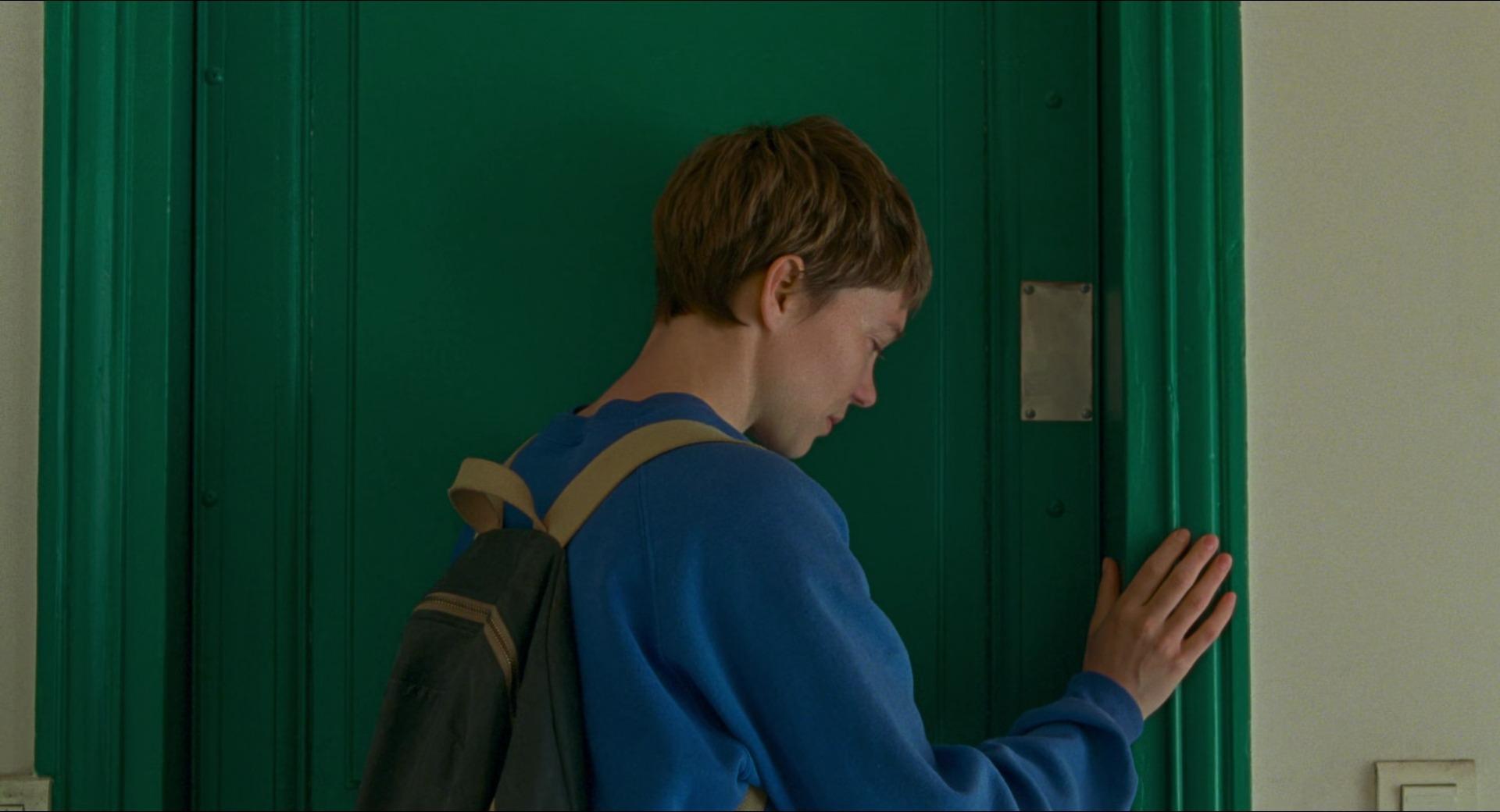
Sandra Kienzler, played by Léa Seydoux, first appears in One Fine Morning (2022) with an olive green backpack, walking down a side street to enter an apartment building in Paris. Holding a plastic bag containing a pastry in one hand and gripping a handrail with the other, she climbs a tall, winding staircase to visit her father, Georg. Afflicted with a neurodegenerative disease that has eroded his memory, he can no longer recall how to unlock the door or read the countless books that line his walls. In a past life, he was a beloved philosophy professor who enjoyed the works of Thomas Mann and Franz Kafka, collecting fountain pens and toy cars in his spare time. Once inside, Sandra unpacks the pastry from the takeout box, provides a brief update on her writing project, then swiftly departs to collect her daughter Linn from school. These repeated gestures constitute her performance in everyday life as a caregiver, a routine with a set of activities and behaviours.
Sandra is a contre-flâneur, always time-bound and walking with purpose, each step she takes bringing her closer to the next stop in her itinerary. There’s hardly an idle moment as she raises her child, tends to her ailing father, and works as a language interpreter. Every hour in her schedule is accounted for, making the discovery and serendipity afforded to Charles Baudelaire’s leisurely figure nearly impossible. It’s a miracle, then, that on her after-school excursion to the park with Linn, she runs into Clément, a married cosmochemist friend she hasn’t seen in a while. (Or perhaps it was destined, given that the actor who plays him, Melvil Poupaud, also starred in A Summer’s Tale (1996), a classic Rohmerian film structured by coincidences.) Their brief encounter sparks a desire to carve more time for herself, and on their second rendezvous—under the pretext of showing Sandra his mass spectrometer—they begin an affair.
A carrier to hold all her belongings for the day, the backpack allows Sandra to seamlessly slide into the many roles she occupies: mother, daughter, widow, sister, friend, interpreter, lover. It contains the laptop used to translate the letters of writer Annemarie Schwarzenbach, notebooks to scrawl shorthand while interpreting speeches, confections and distractions to satisfy a spirited eight-year-old. In a single day, Sandra traverses across various arrondissements, on foot and by metro, to facilitate a panel discussion at the Goethe Institute, entertain Linn at the movies, and observe Georg’s new nursing home arrangements.
"Naturally, a garment or accessory becomes an extension of the body over time, shaping posture and gesture alike."
Naturally, a garment or accessory becomes an extension of the body over time, shaping posture and gesture alike. A stiff pair of jeans will instruct you to stand straight, a billowing shirt will encourage you to spread your arms in embrace. A backpack promises comfort, an invitation to freely bend your limbs or contort your backbone without worrying over ergonomics. In Sandra’s case, it even offers emotional protection. After kissing Clément for the first time, she laughs sheepishly, clutching the straps on her shoulders as if to summon courage. When Georg is transferred from one hospital to another, she grasps onto them like anchors that steady in a strong current. Even in its absence, the persistent load she carries has taught her back to slouch while sitting, to lean against walls in search of contact with another surface.
As her skin bears the impression of the straps and the weight of her miscellanies compresses her spine, we remember the constant that accompanies her throughout the city. Her ever-present bag announces itself against her boyish outfits with two faded yellow stripes. These reminders, by touch or sight, cohere a series of performances given by Sandra during her daily activities—the devoted mother, grief-stricken daughter, secret mistress—into a single, overlapping performance of self with no boundaries. There’s continuity between the person she presents in her different roles, when Clément visits her and Linn at home, or when she sifts through Georg’s library alongside her mother and his former students. She persists as the same unwavering force across conversations and in different settings, consistent in her sensitivity to the world.
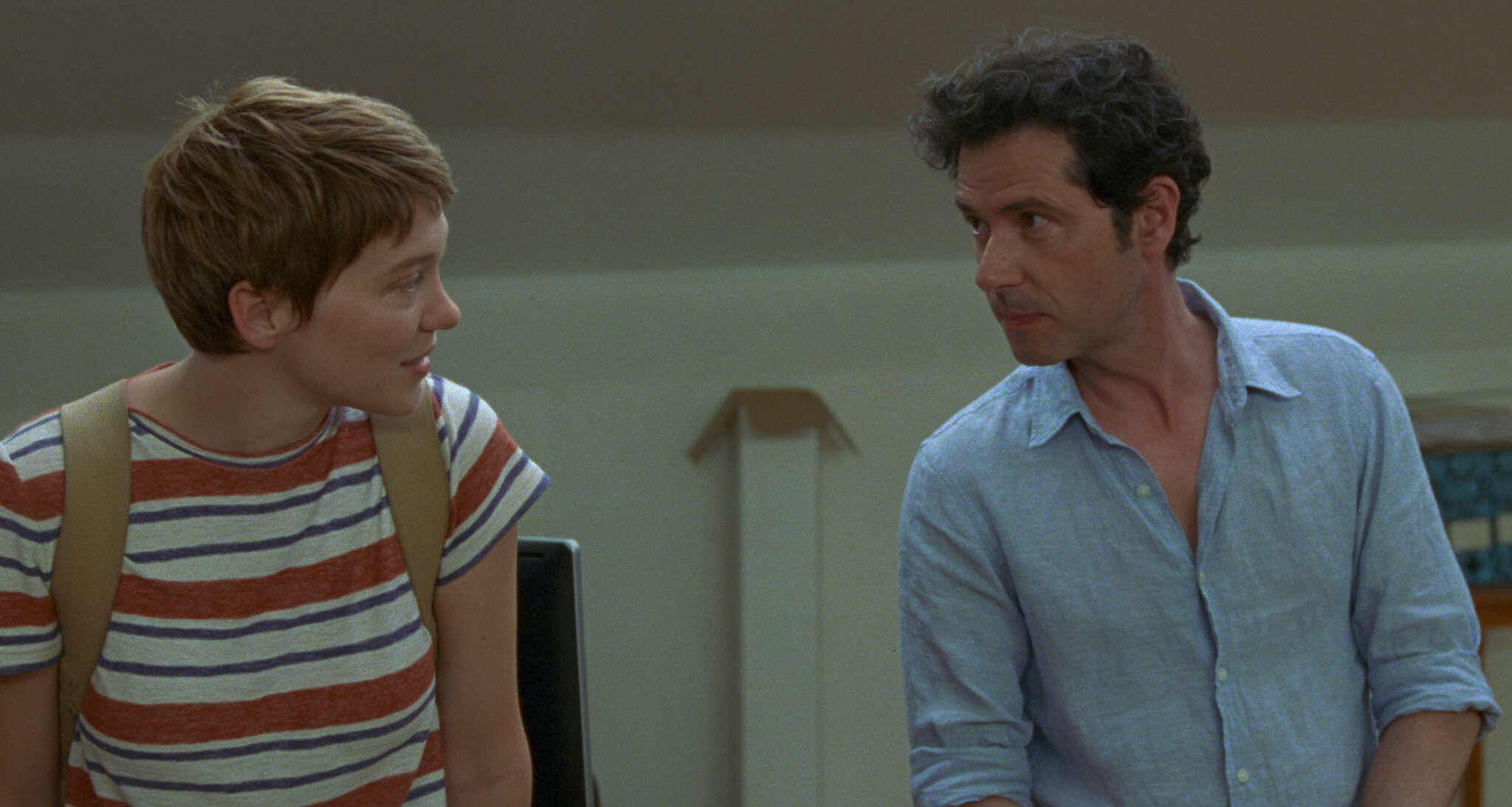
In the realm of cinema, it’s rare to see a grown woman with a backpack when the glamour of a purse, or the luxury of carrying nothing, is within reach. Léa Seydoux herself, an ambassador for Louis Vuitton, has said that the fashion house’s signature leather handbag is a “life-long companion,” ruling out the possibility of flirting with other methods to store her possessions. As a costume choice, the backpack seems to be strictly reserved for itinerant characters with dysfunctional lives, like Greta Gerwig’s Frances Halliday or Kate Winslet’s Clementine Kruczynski. It signals apathy toward trends or desirability, a lack of concern over its association with students and hikers, instead showcasing one’s priorities of functionality and mobility. Sandra refuses the codified performance of the effortless cool girl in French mythology, sporting the clothes and uttering the words of someone who cares enough to wear her heart on her sleeve, or straps, if you will.
By the film’s conclusion, Georg has settled into a suitable facility, and Clément has left his unhappy marriage. On a postcard-perfect day, Sandra’s family of three climbs to the top of the Sacré-Cœur, gazing upon familiar landmarks from the highest point of the city. She’s wearing a compact, red purse on her right side, likely carrying no more than a wallet and keys, standing a little easier and taller. Etched against new scenery, it’s a refreshing departure to witness her strolling at a different pace, a strain lifted from her shoulders, if only for an afternoon. Now with fewer reasons to hurry, and another pair of hands to help with errands, Sandra no longer requires a backpack to carry life’s weight, but it’ll always remain within reach when the occasion calls for it.
A devoted commuter and backpack wearer myself, I recognized a kindred spirit in Sandra: someone who was habitually occupied with their many interests and responsibilities. For a period of my life, I felt the need to keep these parts of myself separate, believing that they were incompatible, a performance for one audience unsuitable for another. If you laid out the items in my bag, you might find a therapy workbook for a morning appointment, a laptop for biology lectures in the afternoon, antique blouses for the tailor between classes, an analog camera to capture a birthday party at a karaoke bar. I resented its heaviness and blamed it for my poor posture, envious of those with empty calendars who could easily return home to unload their inner contents. Years later, I stumbled upon the gentler realization that I became who I wanted to be in that backpack, a vessel that held together my different selves, reminding me that I was just as capacious and capable of contradiction.