


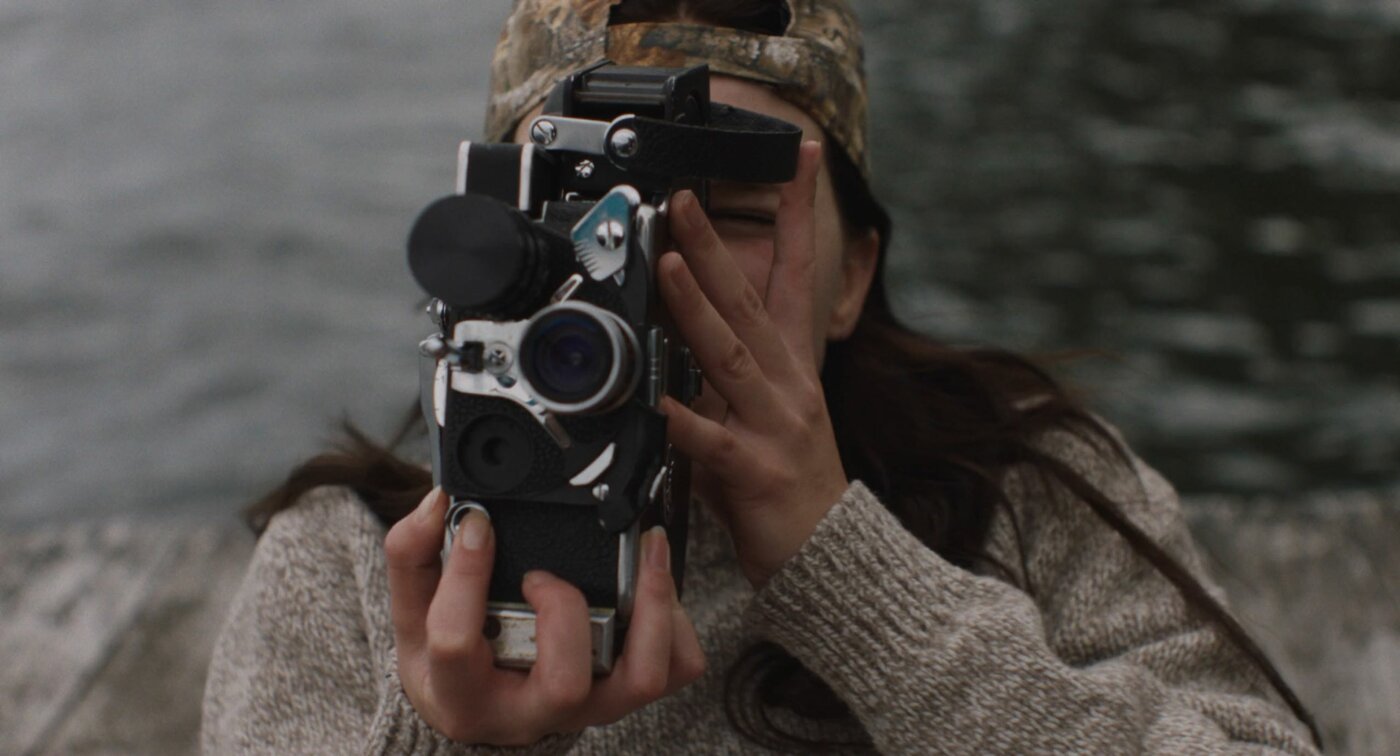
I’m not sure how to start this….
I watch as these words are typed out in real time on a computer screen, the cursor inching forward with each letter. This is how the piece begins, a woman in conversation with her self on the page. It’s in medias res but the res isn’t the high-stakes chronological middle of the piece: it’s the sticky arena of a beginning that hasn’t begun yet.
*
I wish I could claim the above confession of self-doubt as my own, but the words I’m describing belong to the opening of another woman’s story. They appear in the first three minutes of Zia Anger’s 2024 drama-documentary My First Film, typed out on a laptop screen by a young woman named Vita (played by Odessa Young) as she sits at a dark, messy desk in her shadowed bedroom. She’s trying to figure out how to tell the story of making her first film, a feature shot with a rag-tag group of friends in 2010. My First Film is a reflexive, film-within-a-film tale about the pain of creation and the renewal that can follow failure, quintessential aspects of nearly all tales that recount an artist’s first attempt at their art. But Anger’s take on this künstlerroman narrative is unique in that she has frequent conversations with her self (or her self’s stand-in, Vita), sometimes figurative but oftentimes literal.
The eponymous “first film” is Anger’s actual first film, Always All Ways, Anne-Marie, which recounts the story of a young woman searching for her mother, and is listed as “abandoned” on Anger’s IMDb profile page (we see a brief flicker of this page while Vita is typing). My First Film alternates principally between scenes of Vita at her desk and long narrative tracks of her and the crew shooting around the rural town she grew up in. We see her navigating depleted funding, interpersonal feuds with her cinematographer, boom operator, and producer, an unwanted pregnancy, a parasitic boyfriend, festival rejections, and the near-fatality of a cast member. We also see her navigating joy, especially the ecstasy of nailing a shot (or believing that she’s nailed a shot). Vita’s sparsely deployed voiceover provides earnest yet unsentimental observations on what it’s like to be a person making art: “They say filmmakers make versions of the same film their entire lives, and I always wonder, are they this lonely?” The film concludes with a scene of Young, still in character as Vita, and Anger, as herself, embracing and conversing in whispers about how My First Film will end.
*
The seamlessness of their doubling fascinated and even confounded me the first time I witnessed it. Vita is a dramatization of Anger, a character played by an actress, and while this is transparently addressed in the film, it never interfered with my suspension of disbelief. Vita is portrayed with such sincerity and candour that the fact of her artifice as a dramatized character ceased to matter.
The auto-fictional impulse in contemporary film sometimes inspires a certain weariness in me: its tone is often one of heavy-handed irony or cynicism that implies, at best, indifference towards the viewer, and at worst, disdain. But no matter how many times Anger breaks the fourth wall, in place of weariness I feel a pang of familiarity and, unexpectedly, envy: even the essayist must, to a certain extent, dramatize her self on the page, and become a character. Not a fictive one, but nonetheless in measured possession of personality, idiosyncrasy, vulnerability, foible, and even what you might call a narrative arc, even if that arc only pertains to the evolution of her thoughts throughout an essay. In a nutshell, you can’t write persuasive first-person nonfiction if your “I” doesn’t become a character.
It’s a fine line to walk, balancing artifice with honesty and transparency, but I love having constraints when I write, and the challenge of fabricating myself within the internal logic of a nonfiction sentence is one I would never trade. I admit however that part of me gazes as though through an impenetrable glass at something I cannot possess as a writer: the externalization of my self that casting an actor seems to represent. This is a reductive interpretation, but it’s kind of like someone else is doing the work for you. It’s still a constraint I guess. But it looks like more fun.
*
I wonder if Anger would agree with this assessment or not. Is it possible that she too might feel envy? What can she see of the writer’s work of turning her self into a character on the page that I cannot? Dare I turn her into a character here, in order to ask? (Nope.)
*
Carl Dryer’s characterization of his filmmaking as a means of using artifice to strip artifice of artifice certainly applies to what I’m circling in this essay, but I think I prefer another idea described in simpler terms by the French author Annie Ernaux in her autobiographical novel A Girl’s Story. “I started to make a literary being of myself,” her narrator writes, recounting the events that led to her birth as a writer. “Someone who lives as if her experiences were to be written down someday.” This might seem like an impossible feat—to be both inside and outside of your life simultaneously—but it strikes me as a necessary and fertile challenge. One that any artist drawing on autobiographical material must, I think, endeavour towards. And in order to live your life as though you are writing it, you have to turn yourself into a character.
*
Vita sits at her dark, messy desk in a shadowed bedroom writing the story of a formative artistic experience; she is Anger’s incarnation, her character. I sit at my own dark, messy desk in a shadowed studio writing this essay, trying to make a literary being of myself. There is something about writing in the darkness that makes my process easier, maybe because in the shadows, the edges that distinguish and define one thing from the next grow hazy. I am both myself, the writer, and the character being written.
*
I want to ask Anger how she did it, how she managed to split her self in two with such care and dexterity. I want to ask if it has something to do with why she chose the name “Vita” for her stand-in, a word that means “life.” I want to ask if she’s ever read A Girl’s Story.
This conversation could probably, in fact, take place: Anger and I live in the same rural county, and share a close mutual friend. I picture it: the mutual friend introduces us over text, explains to Anger that I love her work and wrote an essay about My First Film. After a few failed attempts at meeting up, we finally get coffee at an old diner near her place. She wears blue and I wear black. We start talking about our lives, order more coffee… but no, stop. I’m not sure how this encounter would unfold. Maybe there’s something to be said for not meeting your idols, because even though she’s not my idol, she certainly is a character in my mind, two characters in fact. And I’m not sure I can bear to add a third.