


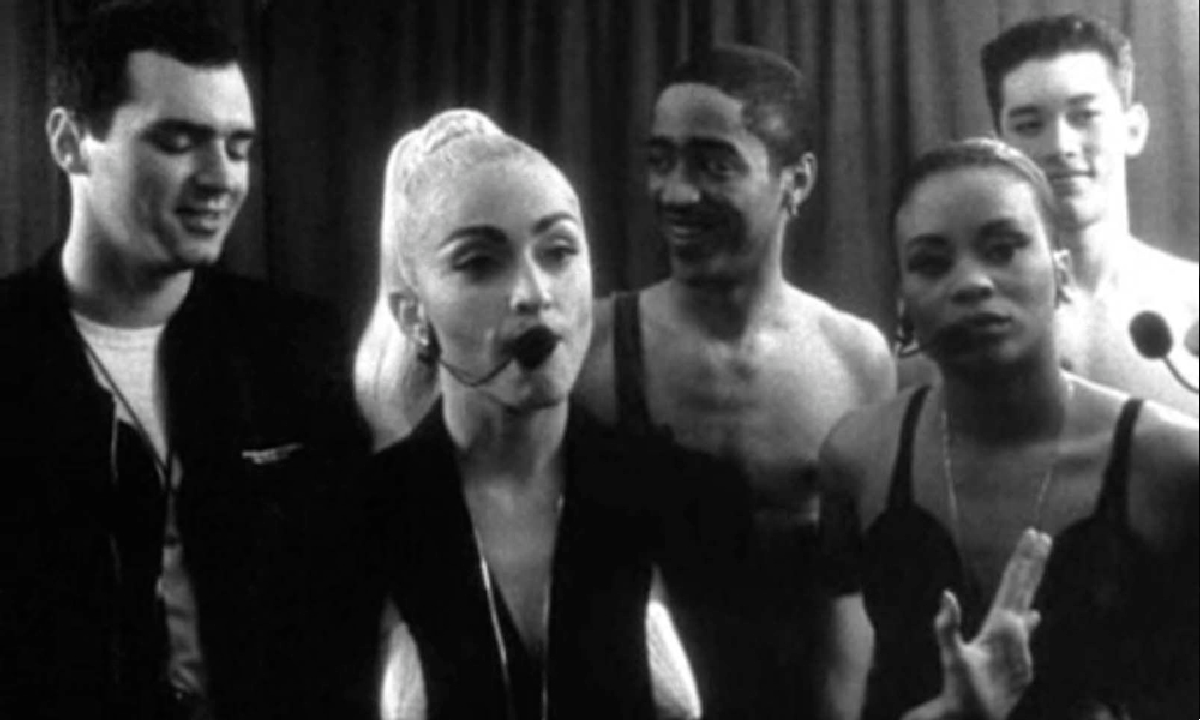
“I think I’m in a state of shock,” Madonna says, opening Alek Keshishian's 1991 documentary Madonna: Truth or Dare, “I’m getting ready for the depression I’m going to feel when the tour’s over.” Madonna is lying on a lounge chair in a Chanel blouse and white pearls shortly after wrapping her 1990 Blond Ambition tour. She was at the peak of her career.
I managed to catch the film at the Revue Cinema on the last day of Pride Month because it felt like the right gay thing to do. I knew Madonna as a great performer; I knew the songs. At its best, the film made me think less about its pop star and more about the structure of relations that make the pop star a phenomenon. To my question, “How does Madonna perform?”, the film attends to Madonna in relation to others around her; others subject to her power and payroll. The film amuses and disturbs as a covert study of performance’s relation to enjoyment, and enjoyment’s relation to subjugation as its ground. Reading Madonna’s 1990s brand as transgression with an all-American face, my question became, “How does one performer reckon with pleasure, sin, and America without reckoning with race, America’s shadow?”
"How does one performer reckon with pleasure, sin, and America without reckoning with race, America’s shadow?"
As a cultural icon and a keystone for our understanding of transgressive art through spectacles like burning crucifixes in her 1989 “Like A Prayer” music video and the infamous 1992 Sex book, Madonna is most interesting in Keshishian's film when we see this transgression originating in her identification with an amorphous racialized other.
In Keshishian’s “truthful” cinéma vérité style, he unloads a sinister subjection beneath Madonna’s empathetic relations with the people of colour she employs, but especially her Black dancers and their makeup artist. Subjection is both the glue and the ground that underwrites the pop star’s seemingly effortless relationship to Blackness. From Madonna kissing a Black Jesus in the “Like A Prayer” video to posturing as a queen mother to her dancing “children” on tour, the documentary makes room for Afropessimism’s notion of Blackness as the ground that makes possible the comfortable existence of the bourgeois subject. To feel alive in the negative, i.e, to transgress, Madonna must feel her way through the socially dead, which is to say, the Black.
In a late scene in Truth or Dare, Madonna plays the titular childish party game with her team in a shaded courtyard. At her first chance, she dares one of her dancers, a tall, dark-skinned Black man named Carlton, to unzip his pants and take his penis out. “It’s literally blue!” she yelps, and the entire table, Carlton included, cackles. The slip from identification with to subjection of the Black dancer is jarringly comical. In Fanonian terms, one might say Madonna identified the Black as a threat on the genital level and labelled him a beast. Bell Hooks said it best in her 1992 essay on Madonna, “Madonna may hate the phallus, but she longs to have its power,” clearly perceiving in Black maleness a quality of masculinity elusive to even white men; a quality she likely envied, internalized, and attempted to stylize from Black male pop stars of the time like Prince and Michael Jackson.
Despite the beastly projection onto Carlton’s penis, it is Madonna who becomes the roving cannibal. Forced to choose between revealing himself or else ruining the fun for everyone, Carlton surrenders himself as food for Madonna’s edgy bit; a phobogenic host, to paraphrase Afropessimist scholar Frank B. Wilderson III, the origin, trigger, and sustenance of Madonna’s love-hate relation to maleness. Like Elizabeth Sparkle in The Substance (2024), shooting up green liquid to produce a more beautiful version of herself, so Madonna the woman consumes this Black man for Madonna the performer to shine a little brighter.
As a Black person, I find myself asking: What kinds of bodies must be staged, consumed, or sacrificed to produce the spectacle of white transgression? What does it mean for Black subjection to furnish the mise en scene and enjoyment of transgressive art? This racial cannibalism is not unique to white artists alone. So, does modernity's entire notion of transgression wear a dark face?
Whether Keshishian or Madonna understood the racial logics of their aesthetics matters little, because the documentary itself reveals this racial relation embedded in Madonna’s most mundane, everyday practices. The star casually says of her dancers, many of whom are racialized, “I think I have unconsciously chosen people that are emotionally crippled in some way. Or who need mothering… it fulfills a need in me to be mothered.” In her desire to finger the wound of her mother’s death from her childhood, the star confesses a perverse attraction to the most degraded human entities, gay men, Black men, and Black gay men. To feel her own humanity as a woman moulded by grief, she appears to look toward humanity's constitutive exclusion, which Humanist logic locates not simply in the racialized other but most potently in the Black subject, or in Wilderson's Afropessimist terms, the "disavowal of blackness as social death."
Social death in Truth or Dare shows up in the documentary’s high-contrast Black-and-white photography. In the scenes backstage, in particular, Madonna shines as everyone else dims. She sparkles as everyone else becomes texture in her shadowy background. Besides casual racism towards Carlton, Madonna pays notable attention to a particular dancer, Oliver, a young Black man with bleached blond hair and the only heterosexual one in the bunch. Madonna seems especially taken with his sad story: he's estranged from his family, jaded by the precarious nature of a dance career, outcast by his peers on tour. But within her empathic relation to Blackness, Madonna remains at the centre. As in her fascination with Carlton’s inhuman penis, Madonna remains the centre of Oliver’s story. Oliver is atmosphere for Madonna’s goodness and horribleness; a canvas for her work as mother-virgin and whore.
This dynamic, Saidiya Hartman describes in Scenes of Subjection as a “facile intimacy that enables identification with the other only as we '’feel ourselves into those we imagine as ourselves.’” Hartman describes here a vampiric logic common to transgressive performance, going far beyond Madonna: the ritual of enjoying and “feeling” oneself by seizing another’s body and wearing their skin. It is Ariana Grande’s now memefied “Blackiana,” Miley Cyrus’s Bangerz era, the blaccent that catapulted Awkwafina to stardom, Elvis Presley’s entire discography: the list is endless.
"Whatever putrid antics this film lays bare did not make me hate or love Madonna any more or less. "
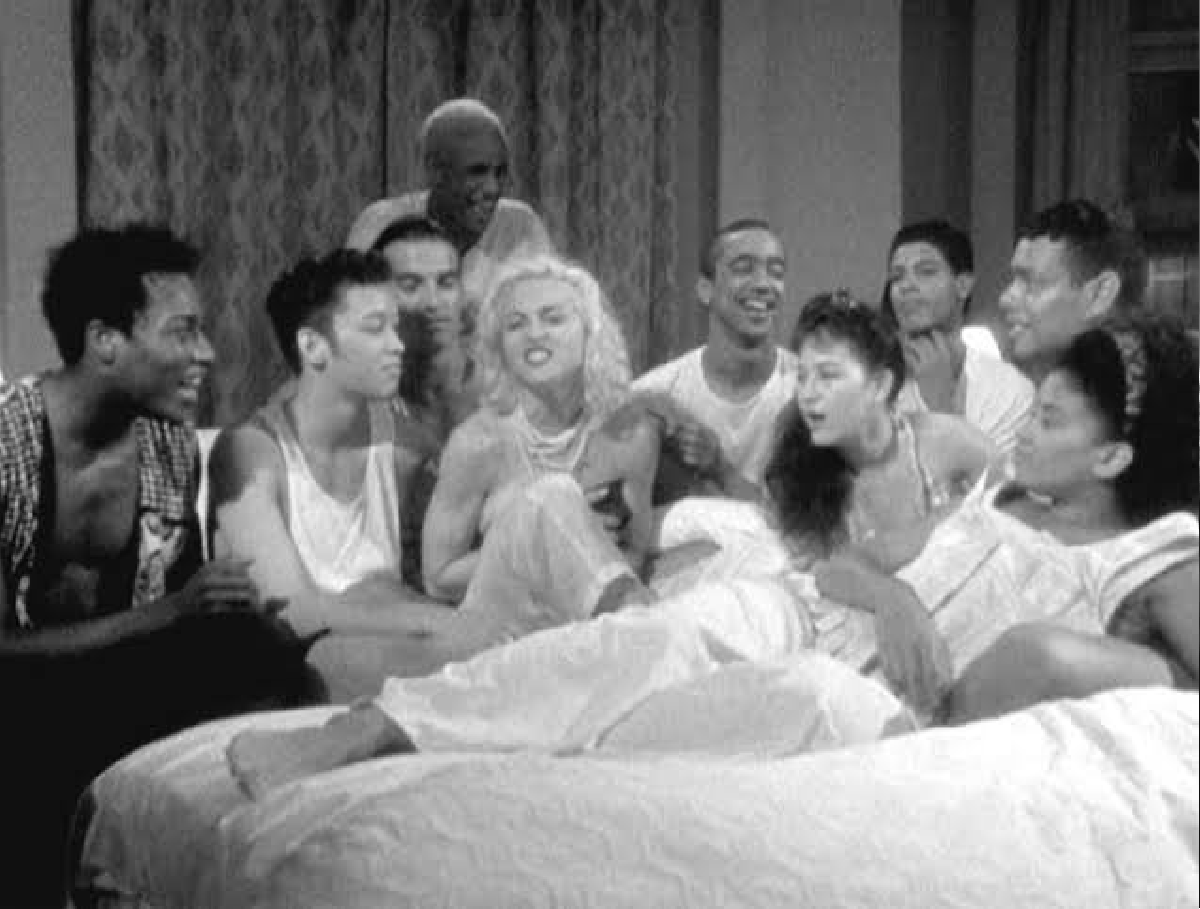
In a final scene in the documentary, Madonna coyly invites her dancers and background singers into bed with her, like children taking turns trudging into the principal’s office. Some of them take their shirts off, some don’t. Some snuggle up to her. Some kiss her on the mouth, but withhold their tongues. In her bedroom, Madonna tells Carlton to take off all his clothes. She then wrestles him naked in her bed, exclaiming how huge his dick is. While he bares it all for her and the camera, she remains clothed. A nest of pearls sits around her neck, a white silk bustier hugs her bust. The documentary’s monochrome picture accentuates the whiteness of Madonna’s blondness against the Black, phallic figure of her naked, aloof, smiling employee. This, I figure, is also where the film’s alternative title comes from: In Bed with Madonna.
Returning to the world after the Revue screening, I was overcome by the smell of hot, ripe garbage sitting over Roncesvalles Avenue. Days before, my Pride weekend was highlighted by a dingy remix of Madonna’s “Hollywood” under a spell of substances in a dark, sweaty room. They like the smell of it in Hollywood, she sings. Whatever putrid antics this film lays bare did not make me hate or love Madonna any more or less. Rather, she became an interesting subject in my thinking about enjoyment, empathy, and the cost of pleasure. In the month since I saw the documentary, she has become one of my most streamed artists. That Tuesday night, I logged the film into Letterboxd with a single sentence: “I love how her nasty spirit leaks out and stains every sweet moment just a little bit #justlikemefr.”