


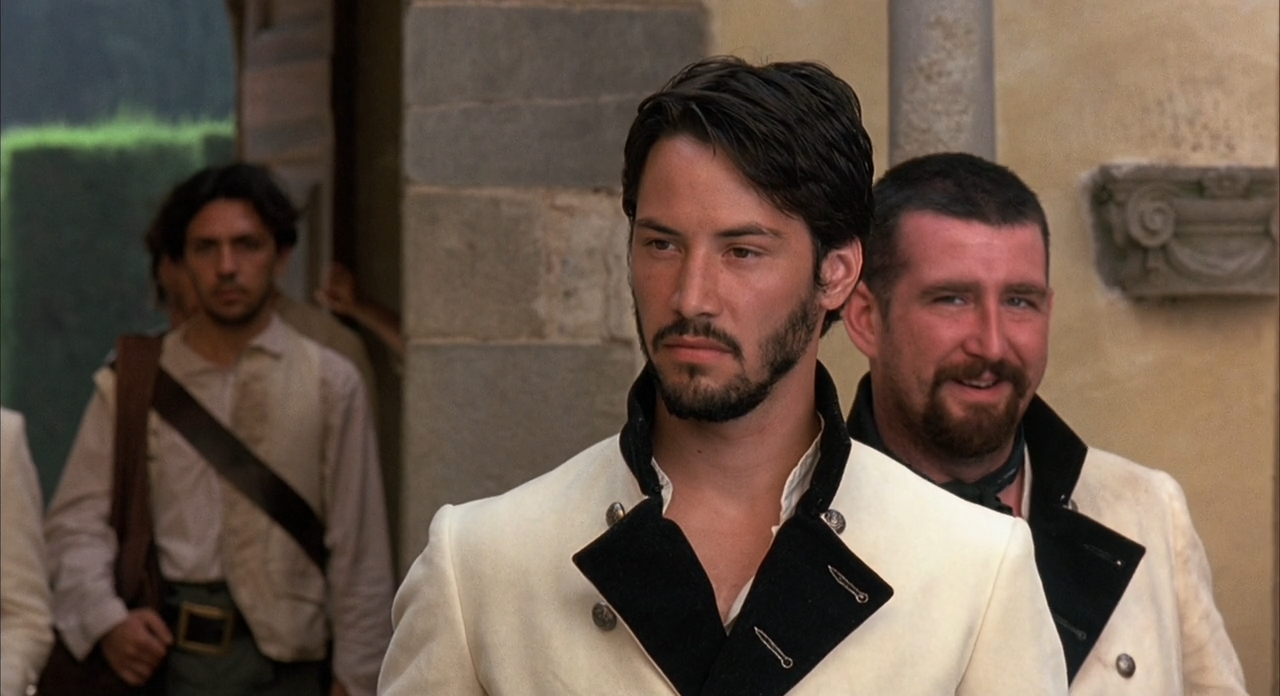
On a cold winter’s night in January of 1995, 30-year-old Keanu Reeves, hot off the success of Speed (1994), took up his riskiest role to date. Maclean’s compared the move to a “daredevil stunt”, one which garnered concern from the public and industry insiders alike. No, he wasn’t driving a bomb-rigged bus or jumping off an airplane into the arms of Patrick Swayze. He was making his debut as Hamlet at the Royal Manitoba Theatre Centre in Winnipeg.
Now, screen actors pivot to the stage all the time. And Hamlet, being perhaps the most famous play in the English language, is a popular choice: the Danish Prince has been played by the likes of Daniel Day-Lewis, Andrew Scott, and even Paul Giamatti. So why did Keanu Reeves’s casting warrant such concern? For one, Hamlet is a behemoth of a role, demanding not only the finest dramatic chops but also comedic timing and stage combat skills—all while credibly delivering iambic pentameter. At this point in his career, Keanu was known for his work in testosterone-fueled action films and playing a time-traveling teen in the Bill and Ted franchise. Much of the humour in the latter is predicated on the idea that a guy like Keanu could not exist outside of 1990s California—a premise which is proven true in films like Bram Stoker’s Dracula (1992), where his very presence on screen feels like an anachronism. Plus this wasn’t Keanu’s first attempt at Shakespeare—his performance as Don Jon in Much Ado About Nothing (1993) earned him a “Worst Supporting Actor” nomination at the Razzies, with Rolling Stone noting that the text did not “fall trippingly off this surfer dude’s tongue.” How was Keanu “young, dumb, and full of cum” Reeves going to pull off the Prince of Denmark?
"How was Keanu “young, dumb, and full of cum” Reeves going to pull off the Prince of Denmark?"
Watching some of his early roles, you might be quick to assume that Keanu’s career began by accident. It’s easy to imagine him climbing off his motorcycle and, in a state of perpetual confusion, wandering in front of a camera where, charmed by his beauty, no one had the heart to call cut. But in reality, he got his start as a teen actor in Toronto. He was even a Drama major at the Etobicoke School of the Arts—as was I, some 30 years later. Unlike Keanu, who was kicked out for poor behaviour, I made it to our Grade 12 Shakespeare unit and, if you buy me a couple drinks, I’ll recite my Juliet monologue with an impassioned sincerity only a former drama kid could possess. Keanu’s expulsion did not dissuade him, though, and he continued to pursue acting, booking a couple of television parts and studying theatre outside of school. The very rebellious instincts that got him in trouble at ESA would end up getting him cast in a production of Romeo and Juliet when he interrupted someone else’s audition to beg for the role of Mercutio. This is when he first worked with director Lewis Baumander who, years later, after Keanu moved out to LA and made it as a movie star, called him up and asked if he’d play Hamlet. Agreeing to do the play meant turning down a seven-million-dollar role in Heat (1995) in exchange for the measly salary of a Canadian stage actor and braving the Manitoba winter. He said yes.
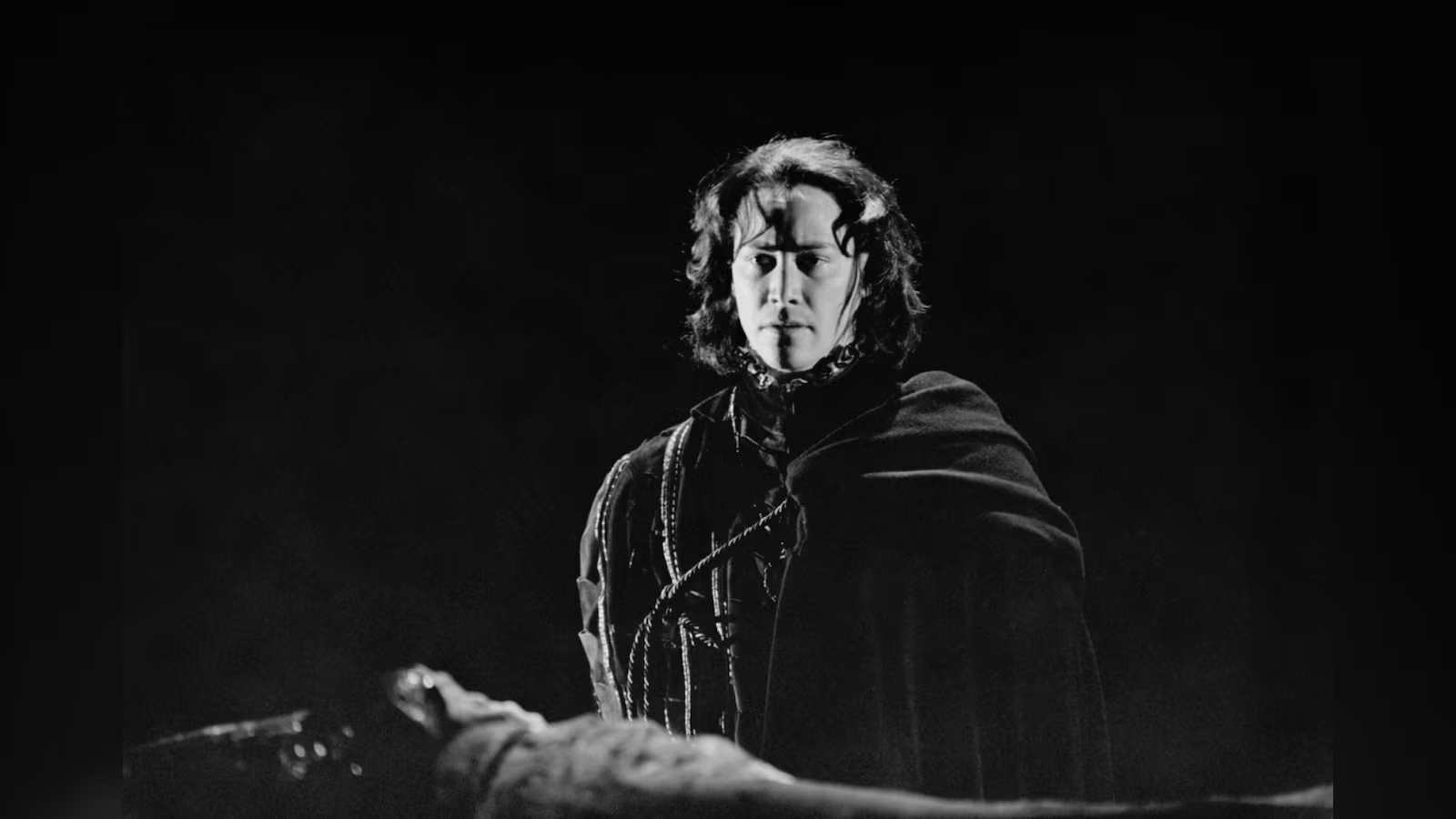
Keanu’s love for Shakespeare is well documented in media profiles. However, it’s often brought up in a somewhat mocking manner, like in this particularly snide Rolling Stone piece where the writer notes the “boyish gusto” with which a then 35-year-old Keanu speaks about the Bard. Decades before the phrase “performative male” would enter popular vernacular, haters were poking fun at him for earnestly memorizing sonnets. He began learning Hamlet while shooting Speed, later telling Rolling Stone that he was able to do so because the film left him with a lot of room in his head. And, leading up to the play, he studied the fundamentals of Shakespeare with Baumander, familiarizing himself with prose, verse, and rhetorical speech. Did his preparation pay off? Unfortunately, we’ve been deprived of any recordings of Keanu’s performance, which means I am unable to give my own assessment. Much like Shakespeare writing in Elizabethan England about a medieval Danish prince, I am forced to rely on historical accounts to tell this story.
The play got off to a rough start. Keanu, perhaps struck with opening night jitters, was apparently rushing his lines “like a schoolboy dying to get to the end” (Macleans). But, considering how multiple critics reported their surprise that Keanu managed to remember his lines at all, who can blame him for being a little nervous to perform for this audience? It wasn’t just the pacing that fell flat. At the beginning of the play, Hamlet has returned from school following his father’s sudden death, and finds his mother has very quickly moved on with his uncle. He’s tormented by grief and feelings of betrayal and, like many university-aged men, copes with his emotions by brooding about and making them everyone else’s problem. Reviews called Keanu’s performance in these moments “bloodless” (Winnipeg Free Press) and “thin” (The Globe and Mail). This isn’t hard to believe. There’s a characteristically Gen X disaffectedness to Keanu that I can see translating poorly to the stage. It likely didn’t help that he kept his movie-star voice, a voice that sounds perfect saying “party on, dudes!” but harder to imagine in Act 3, Scene I, when Hamlet, unsure if he should continue his suffering or risk the unknown of the afterlife, gives the iconic “to be or not to be” soliloquy. Spoiler alert: Hamlet chooses life. He also chooses revenge and, in this pursuit, descends into madness, triggering a turn in both his characterization and, according to reviews, Keanu’s performance.
"He is a testament to the power of vibes, living proof that sometimes the most powerful thing you can be in this world is a cool dude."
While Hamlet is often portrayed as the prototypical tortured sad-boy, Keanu’s take on the character was bloodthirsty and vengeful. He is, first and foremost, an action hero and it sounds as though he found his footing once the stakes of the play were raised, after Hamlet confirms his uncle Claudius killed his father and begins plotting his murder. As someone who hated the play in high school, at this point I’d had enough of overly-sensitive creative types, I’d personally love to see a crazed-himbo Hamlet. But what about the critics? The Ottawa Citizen concluded that “Reeves never disgraces himself,” while Maclean’s wrote “Even when his delivery was lacking, there was something intriguing about his presence.” Perhaps the consensus can best be summed up by the Globe and Mail: “Keanu Reeves is not a bad Hamlet.”
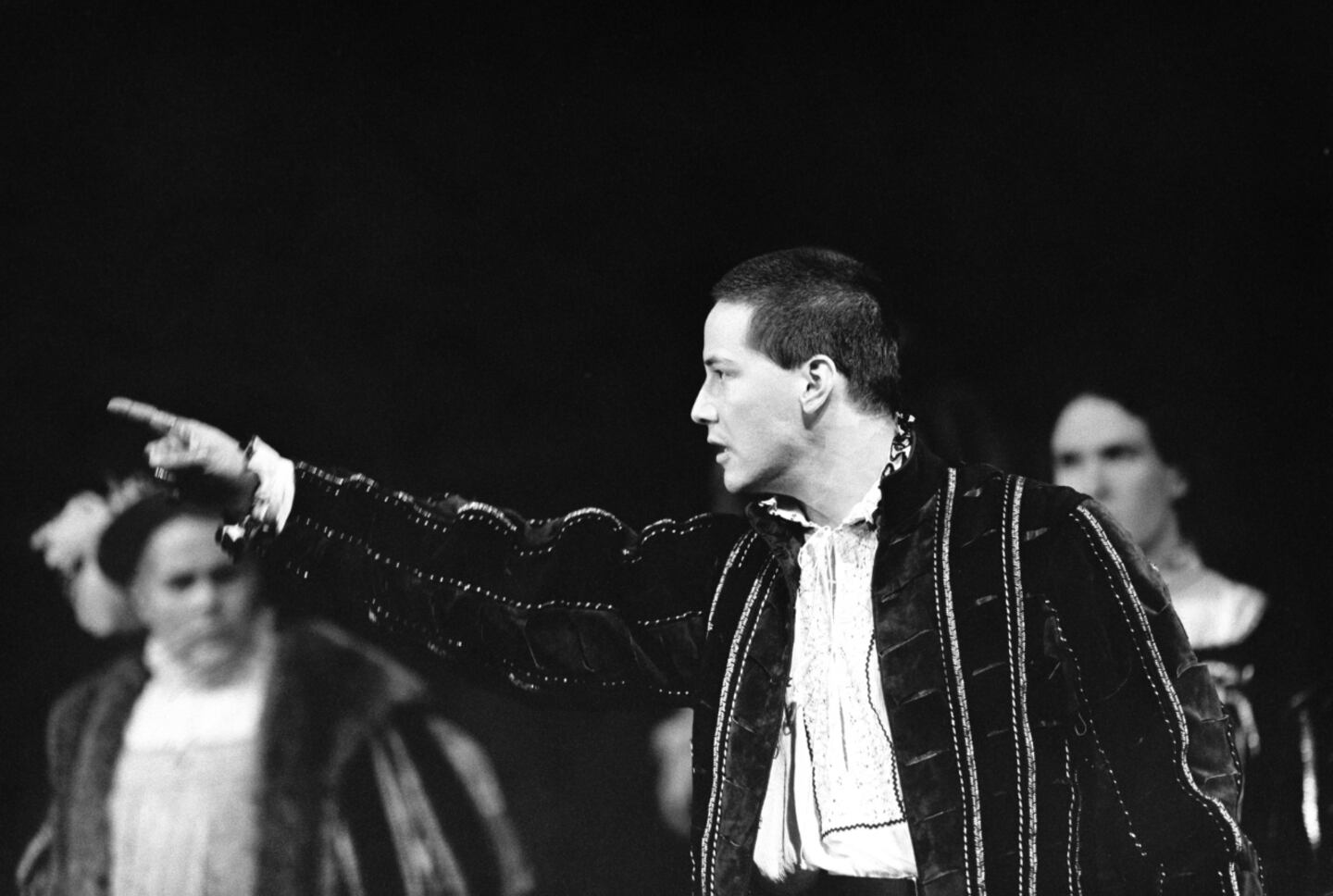
These reviews, which are both condescending and encouraging in a singular breath, speak to an impulse that Keanu Reeves triggers in so many of us. I have found myself, on countless occasions, beginning one of his films completely resistant to his performance only to find myself won over by the end. There’s just something about him. Even when he so woodenly lives up to his nickname “Canoe Reeves” or, in the case of Hamlet, fails “to achieve the fusion of sound and meaning” (Ottawa Citizen), he leaves us confusingly compelled and under his unique spell. He is a testament to the power of vibes, living proof that sometimes the most powerful thing you can be in this world is a cool dude. Reflecting back on the critical reception to the production, former artistic director of the Royal Manitoba Theatre Centre, Steven Schipper, told CTV, “They came expecting Kenneth Branagh, and Keanu was going to be Keanu.”
Keanu is Hawaiian for “cool breeze over the mountains”. This is an easily Google-able fact, but I learned it from my father—a former classmate of Keanu's—who says that he was the first person at their middle school that the future star disclosed the meaning of his name to. They were good friends for a couple years before losing touch as teens. One time in high school, my dad ran into Keanu while en route to a theatre rehearsal. My dad remembers being really surprised that his old friend had taken up acting. Keanu Reeves has been prisoner to the low expectations of others since the beginning. But no matter how hard society, the gatekeepers of Canadian theatre, or my dad may try, you can’t imprison the breeze.