


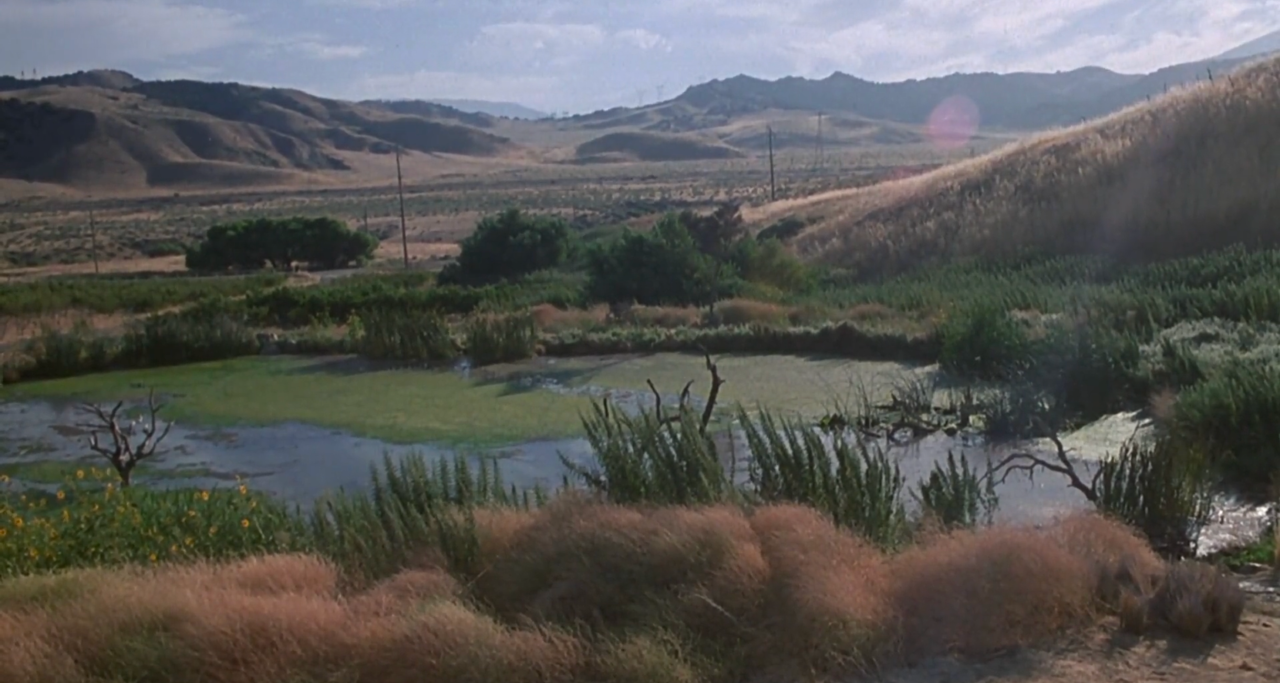
In this same spirit of suggestive addenda, Psycho '98's final shot extends past the original's abrupt “The End,” mirroring the opening's omniscient starter pistol—the camera follows Marion's car, and her corpse inside, out of the Bates's backyard bog before craning upward to observe the surrounding crime scene. Expanding the frame on this pitiless, procedural exhumation, Van Sant's viewpoint floats skyward, settling on a sunlit vista as police cars depart the frame. We hang there, watching the horizon for more than two minutes, waiting in vain for something—other than cars traversing the distant highway—to appear. Similar to its opening sequence, this ending's literal suspension on the precipice of meaningful incident or transformation offers a (dis)satisfying summation of the preceding 100 minutes.
In his thoughtful and thorny assessment of the film back in 2007, Michael Koresky characterizes this scene's conceptual bite while also illustrating how the film's successes and failures are intertwined. Obsessing over Psycho's myriad changes large and small can feel counterproductive (especially now, in the context of a column that takes up such films “in their own right and on their own terms”), but Koresky reminds us that “scanning the boundaries of every one of its frames for minute alterations in composition, construction, and performance, each viewer of Psycho finds either something or nothing, but they were looking.”
---
In this spirit, I will wind back the clock about 10 or so minutes from Psycho's final frame. Lila Crane (Julianne Moore), in search of a reclusive matriarch, has stumbled into the basement of the Bates house. Like Norman's office back in the motel, the room is bedecked with taxidermied birds (which he says are “sort of passive” to begin with). Chirps and wingbeats flood the soundtrack. Lila finds the figure of an old woman glimpsed from behind, seated in a wooden swivel chair, framed by sheer curtains, awash in harsh fluorescent light. In the original film, Lila Crane (Vera Miles) found the shriveled corpse of Mama Bates in a small, dark room surrounded by fruit crates. In front of Van Sant's Mrs. Bates, however, a flock of live birds flits between the branches of a prop tree and teems together at the roots below—a morbid play on the skeletons in the closet.
---
Psycho '98, like Psycho '60, climaxes rather abruptly. Norman is detained offscreen, and in the original's most contentious sequence, a psychologist breaks down his insanity in blunt, expository terms. Hitchcock shoots the scene with an equivocal theatricality, his camera slightly amused by the doctor's smug bloviating. This doesn't entirely negate the sense of diminishing returns, but Hitchcock seems to understand the folly of the screenplay's attempts at wrapping its tangled psychic knots into neat little bows (Norman's final Kubrick stare confirms and undermines our sense of closure in the same breath). Van Sant takes a different tack, opting for more close-ups on the ever-earnest Robert Forster, who recites his explanation with a dutiful sense of bafflement. Preemptive echoes of “she wouldn't even harm a fly” and the end credits music, however, drown out almost the entire scene.
Both filmmakers are resistant to the constraints of easy solutions, and their methods of distorting these parameters capture their respective approaches to film practice. Hitchcock's frames, per usual, are mordant and exacting, rigged to italicize their own disturbed viewpoint. Van Sant, in spite of his best efforts, is a sincere image-maker and an emotionally intuitive formalist; his distancing techniques usually bring the viewer boomeranging closer, and his critical edges are expressed as annotation, the elements outside each frame that ultimately shape their meaning. There's a purity to his approach—a trust in the viewer, a trust in the image—that sets him apart from his more sinister forebear.
"There's a purity to his approach—a trust in the viewer, a trust in the image—that sets him apart from his more sinister forebear."
It might seem strange to evoke purity in conjunction with a project that was always meant to be compromised; in “Gus Van Sant: The Art of Making Movies,” Katya Tylevich places his remake in a Hollywood landscape where studios had begun dredging up their IPs, from The Flintstones (1994) to The Brady Bunch Movie (1995), for a quick buck. In their first attempts at wooing Van Sant, Universal encouraged him to “explore their library” for inspiration. While their talks were still in limbo, the director had apparently lined up a remake of Seconds, with Brad Pitt in the Rock Hudson role, at Paramount.

Commercial viability was evidently not a concern for the director once executives signed the checks (conflicting budget reports put the price tag somewhere between 25 and 60 million USD), but the industrial factors that got Psycho greenlit are still significant. The film, like its title character, vibrates with sickness and self-hatred, and its maker’s deal with the corporate devil pleasurably parallels a leading lady who takes the money and runs. In turn, Marion’s decision—thwarted by her murder—to bring that money back to her employer is a saving grace mirrored by Van Sant’s ultimate refusal to fall in line with profitable practice and make the film his way.
"Like the sprawl of uncaring highways beheld beyond the Bates property in the final shot, the Hollywood machine keeps on indifferently humming."
It would be tempting to say that in doing so, the director flung tens of millions of dollars into the proverbial swamp. But when a film like this one flops, a few deep-pocketed opportunists stand to lose and, with time, the culture stands to gain. Like the sprawl of uncaring highways beheld beyond the Bates property in the final shot, the Hollywood machine keeps on indifferently humming. Unlike the mudcaked money impounded as evidence and enjoyed by no one, however, we the people share the profit of Van Sant’s costly passions.
When the whereabouts of the stolen cash are finally questioned, our psychologist reminds the room that these were crimes of passion, not profit. What Van Sant seems to proffer with his gorgeous, failed passion product is: why not both?