



It was only much later, probably around my first year in grad school in English, that I realized exactly what people are after in these feats: mastery. To be efficient, productive. To winnow something down under your control, to measure your success in objective milestones. To be a good capitalist. To rank yourself against others. To hone your muscle memory to a mechanical point, enough so that you can hookshot yourself across Ocarina’s Water Temple at just the right moment and complete it without actually going through it.
By then, of course, I was in a discipline that often clung to the ways art can also be mastered. Identify the meter in a poem and build an argument around it. Apply a modern theory to an earlier text. Crack the biographical background of a line. Textual evidence, textual evidence, textual evidence. It was a mastery of meaning. (That the university itself became more capitalistic even as it increasingly relied on the ideology of priceless passion to underpay its grad students is another, if related, story).
"When it comes to mastery of meaning, nothing is more powerful than an ending; the very fact something is coming to a close exerts a gravitational pull on meaning."
When it comes to mastery of meaning, nothing is more powerful than an ending; the very fact something is coming to a close exerts a gravitational pull on meaning. A pat ending (“and there you have it”), an ambiguous ending (“it's yours to discover”), it doesn’t matter. We fear our own deaths, and we scrabble for any sign that when something is over, it means something. And I get it: I too have mortal fear! I also want art to reach out to me, to give me a sign! But so often we insist that this sign, especially when it comes at the end, give us a sense of control and confirmation.
Which is why we can become incensed at endings we don’t like, that we feel break the contract of the meaning we’ve been promised. When I read I Capture the Castle (1948) as a tween and Cassandra didn’t want to be with the beautiful and devoted and PERFECT Stephen (I am square at heart), I wanted to dig up Dodie Smith from her grave and ring her neck, because how dare a teenaged girl make an unwise decision? How dare that be the thrust of this ending, this book? This feeling was so powerful, I still had to grind my way through the 2003 film a decade after it came out, long after I’d made plenty of my own suspect decisions.
Only, I don’t want to approach media like I’m 12, and I don’t want it to approach me that way, either. Indeed, I’m now often repelled by meaning, especially the sense I can and should control it. I want art to meet my gaze, yes, or intentionally look away (hot), but I don’t want it to beg for my stamp of approval of its raison d’être (ew, Stephen). I know Pretty in Pink (1986) would be miles more interesting if the ending had actually shown Andie with Duckie, before test audiences scrapped that.
"[...] on the other hand, I’m not sure true endings exist much these days."
Of course, on the other hand, I’m not sure true endings exist much these days. Sequels, reboots, television series limping past their due date, cliffhangers. The never-ending newness of late capitalism: no endings, just the next thing and the next thing (Marvel test audiences even resurrected Loki at the end of 2013's Thor: Dark World). As a result, for a certain genre of criticism, deriving meaning becomes mastery of the future rather than grappling with what you’ve just experienced. Cast predictions, sneak peeks, hot takes, accruing more comments and eyeballs. Anticipation and growth, not endings.
So, anyway, now I have ending anxiety. I don’t want to master its meaning, solve it like an easter egg, and I don’t want to watch some wheel-spinning cliffhanger. I’m trapped between over-abundance and utter paucity of meaning. I haven’t finished more than three seasons of any TV show in years, unless you count like Vanderpump Rules, which will never bother me with any pretense of deeper significance unless I want to project onto it (which to be fair, I do). When I feel this way and there’s no reality TV to be had, all I want is to watch the ending of Michelangelo Antonioni’s L’Eclisse (1962).
---
Monica Vitti’s Vittoria and Alain Delon’s Piero are new lovers unsure about each other, and when they agree to meet at their usual rendezvous spot one night, neither of them shows up. Instead, L’Eclisse ends with a protracted scene of everything but the characters you have just followed for the last two hours: People waiting for the bus, a woman who only looks like Vittoria, a streetlamp, on and on for seven minutes of confounding bliss.
I get that the ending of L’Eclisse, an almost-dare to extract meaning that so many have jumped on, doesn’t at first seem like fertile ground for my particular needs. Yes, maybe it is a mobius strip running all the way to its beginning, where an exhausted Vittoria ends her relationship with her fiancé. Yes, I think it is a statement on modernity and alienation, but why in this way?
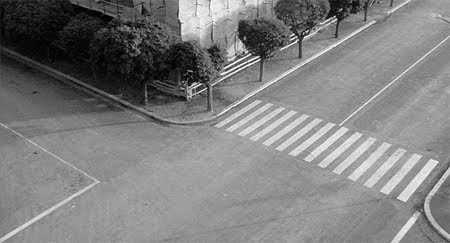
Actually, don’t answer that. I most feel I am most comforted by L’Eclisse’s ending when I think of it as a dead thing. Not an open, ambiguous, difficult coda, but a dead end, a refusal. Something that turns away from me. It’s no surprise it has a haunted, almost horror-movie quality to it as the streets empty over a sparse soundtrack. I am being warned: go no further.
The stock market—a temple to masculinity, to mastery, to capitalism—features prominently. It’s a hive of controlled chaos that crashes one day and reveals just how illusory that sense of mastery was, how meaningless. Where does the money go? Vittoria asks. No one knows. If I had to compare anything in L’Eclisse’s ending to what came before it, it would be this: Like the stock market, the film is plummeting, it has lost its faith in itself, its treasures are illusory.
"Have you really given two of your hard-earned hours to something that refuses to meet your eyes in the final moments?"
And yes, there’s frustration here. Have you really given two of your hard-earned hours to something that refuses to meet your eyes in the final moments? Well first, stop treating your life like a time trial, earning mastery in the minimum amount of duration. I don’t think it’s a coincidence that “to get” something evokes ownership, private property, land that owes you production. The last moments of L’Eclisse are most rewarding for me when I stop trying to get at it and when I inhabit its alienation. Alienation isn’t meant to be solved.
Which isn’t to say the ending of L’Eclisse is the end of criticism. It’s not a sign to stop trying to understand. It’s only the start. Art may have no right answer, though there are certainly wrong ones—I just don’t think bewilderment belongs in the latter category simply because it admits a lack of mastery. Yes, Ocarina’s Water Temple is legendarily annoying (Nintendo even later issued a formal apology for creating it), but you’re not a dupe for exploring it, for being frustrated by it. To understand something partly, imperfectly, for a reach to exceed grasp: isn’t there where the best criticism comes from, what the best art produces? Feeling a distance at the end of L’Eclisse doesn’t mean abandoning it; it only means feeling it.